-
PX Consulting
- November 10, 2025
Most founders dream of building a team that works with the same intensity, ownership, and vision that ignited their own journey. Yet paradoxically, many find themselves trapped in endless review cycles—approving every decision, scrutinizing every detail, second-guessing every initiative.
Here’s the uncomfortable truth: the tighter you grip control, the less freedom you actually have. And when your team loses freedom, something fundamental dies—they stop thinking and start merely executing.
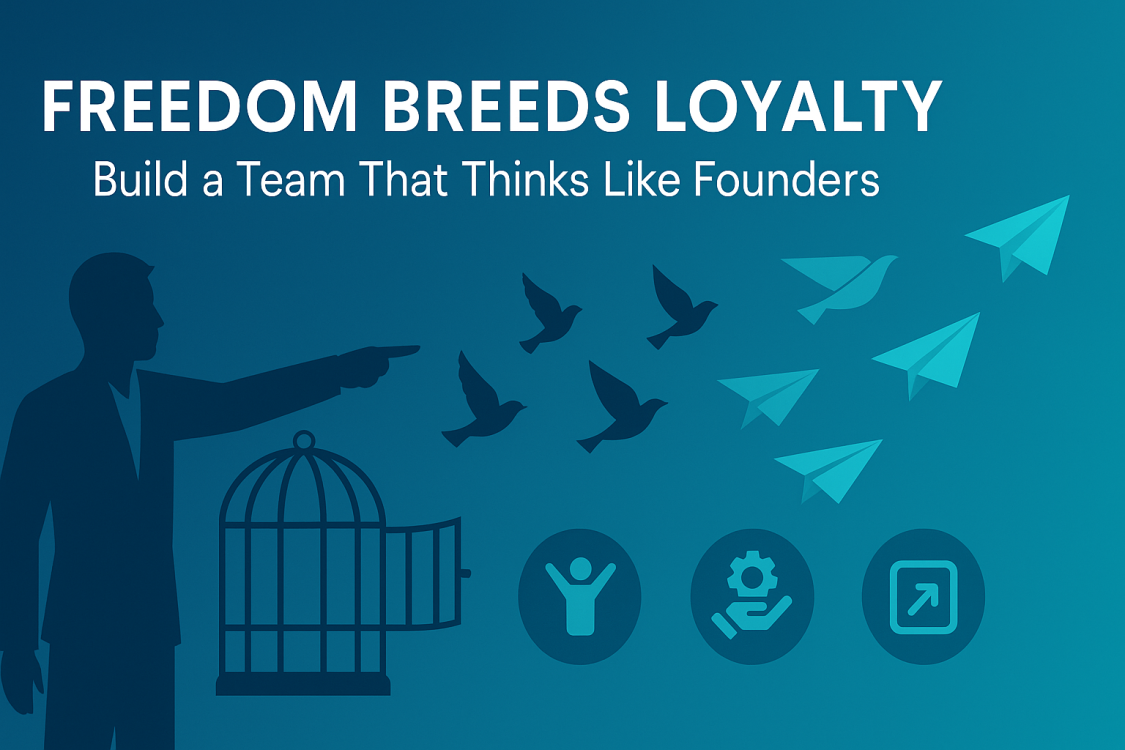
If you genuinely want a team that thinks and acts like founders, the path forward isn’t paved with control systems and approval workflows. It’s built on trust, autonomy, and strategic letting go.
The Neuroscience of Ownership
The human brain doesn’t just respond to autonomy—it craves it. Neuroscience research shows that when people experience genuine agency, their prefrontal cortex lights up with the same patterns seen in intrinsic motivation and creative problem-solving.
Autonomy activates three fundamental psychological drivers:
Purpose – “I understand the deeper meaning of my work”
When people see how their efforts connect to larger outcomes, work transforms from task completion to contribution.
Mastery – “I’m becoming exceptional at something that matters”
The desire to improve isn’t manufactured through incentives—it emerges naturally when people have the freedom to experiment and grow.
Responsibility – “I own these results”
True accountability can’t be imposed from above. It only develops when individuals have real authority over their decisions and their consequences.
Here’s what most leadership books won’t tell you: these motivators can’t coexist with micromanagement. They require psychological safety, decision-making authority, and the real possibility of failure.
🧭 The Intrapreneur Transformation
You’ve heard founders say it countless times: “I need my people to think like owners.” But here’s the gap—thinking like an owner requires working like an owner: with genuine autonomy, clear decision rights, and freedom to chart the path.
The Five-Stage Empowerment Framework:
Stage 1: Context Over Commands
Don’t just assign—explain the “why”
Share the business context, customer impact, and strategic importance. When people understand the full picture, they make intelligent trade-offs instead of blindly following instructions.
Stage 2: Outcomes Over Methods
Define the destination, not the route
Specify what success looks like, then step back. Some team members will take the scenic route. Others will find shortcuts you never imagined. Both are valuable when the outcome is clear.
Stage 3: Smart Risk-Taking
Create safe spaces for calculated bets
The difference between recklessness and innovation is thoughtful risk assessment. Teach your team to evaluate potential downside, gather data points, and make informed decisions—then protect them when those decisions occasionally fail.
Stage 4: Results-Based Reviews
Measure impact, not activity
Stop tracking hours, emails, and meeting attendance. Start asking: “Did we move the needle? What did we learn? How do we improve?” This shift transforms your team from performers to problem-solvers.
Stage 5: Recognition Rituals
Celebrate initiative, not just outcomes
The team member who identifies a problem early deserves recognition—even if the solution fails. The employee who proposes a bold experiment shows founder thinking—even if results are mixed. What you celebrate, you multiply.
⚙️ The MSME Founder’s Dilemma
In small and mid-size businesses, there’s a brutal irony at play: the founder who built everything often becomes the ceiling preventing growth.
When every decision requires your approval, you create an invisible bottleneck. Your team learns to wait instead of act. They bring you problems instead of solutions. They optimize for your approval rather than customer outcomes.
But here’s what happens when you treat employees like trusted advisors instead of supervised workers:
- They start seeing opportunities you’re too busy to notice
- They solve problems before they reach your desk
- They take pride in their independence and deliver beyond job descriptions
- They stay not because they’re paid well, but because they’re trusted deeply
The freelancer principle: Notice how freelancers often perform exceptionally? They’re given a problem, trusted to solve it, and evaluated on results. No daily standups. No activity monitoring. Just outcomes and accountability.
What if you managed your full-time team with the same trust you extend to top freelancers?
🚀 The Loyalty Equation That Actually Works
Here’s what doesn’t build loyalty:
- Competitive salaries (they buy presence, not passion)
- Generous benefits (they create comfort, not commitment)
- Team-building events (they’re enjoyable but forgettable)
Here’s what does:
- Being heard when they have ideas
- Being trusted when they make decisions
- Being supported when they take risks
- Being valued beyond their output
Loyalty flows from emotional equity—the accumulated feeling that this place believes in me, invests in me, and trusts me to make meaningful contributions.
As a founder, your ultimate role isn’t monitoring your team’s work. It’s expanding their capacity to think strategically, decide confidently, and own completely.
🔑 Your 7-Day Freedom Experiment
This isn’t theory—it’s an experiment you can run this week:
Day 1-2: Choose one project or team where you’re currently the bottleneck. Document every decision currently flowing through you.
Day 3: Meet with the team. Clearly articulate:
- The desired outcome (be specific and measurable)
- The boundaries (budget limits, timeline, non-negotiables)
- The decision authority they now have
- How you’ll measure success
Day 4-6: Resist the urge to check in, offer suggestions, or “just quickly review.” This is the hardest part—sitting with the discomfort of not knowing every detail.
Day 7: Review outcomes together. Ask:
- What decisions did you make?
- What surprised you?
- What would you do differently?
- What support do you need going forward?
Watch what happens when you give intelligent people clear outcomes and real authority. You might be surprised—not by their competence (you hired them for that), but by their creativity, resourcefulness, and commitment when genuinely trusted.
🌟 The Leadership Paradox
The less you control, the more influence you have.
The more you trust, the more loyalty you earn.
The more freedom you give, the faster you grow.
Freedom isn’t the absence of standards—it’s the presence of trust combined with clarity. It’s not about working without structure—it’s about building structures that empower rather than constrain.
Your team doesn’t need more supervision. They need more space to think, experiment, fail, learn, and ultimately become the leaders your growing business requires.
Freedom is the seed. Loyalty is the fruit. Vision is the harvest.
When you create an environment where people can genuinely think and act like founders, they don’t just stay with you—they build alongside you.
What’s one area where you could loosen control this week? What outcome would you define, and what authority would you delegate? The teams that will win the next decade aren’t the ones with the tightest controls—they’re the ones with the deepest trust.
The Perception Insights Newsletter
By Vinod C. Pandita, Founder & CEO
PX Consulting & ABLE