-
PX Consulting
- November 26, 2025
Many MSME founders obsess over profits—sales targets, margins, revenue growth. The relentless chase for numbers feels necessary, even virtuous. After all, without profits, there’s no business.
But here’s what nobody tells you: focusing exclusively on profits creates businesses that burn bright and burn out fast.
You hit your targets. You grow revenue. Yet your team feels disengaged. Your customers see you as interchangeable. Your competitors replicate your model. And you, the founder, wake up exhausted, wondering why success feels so hollow.
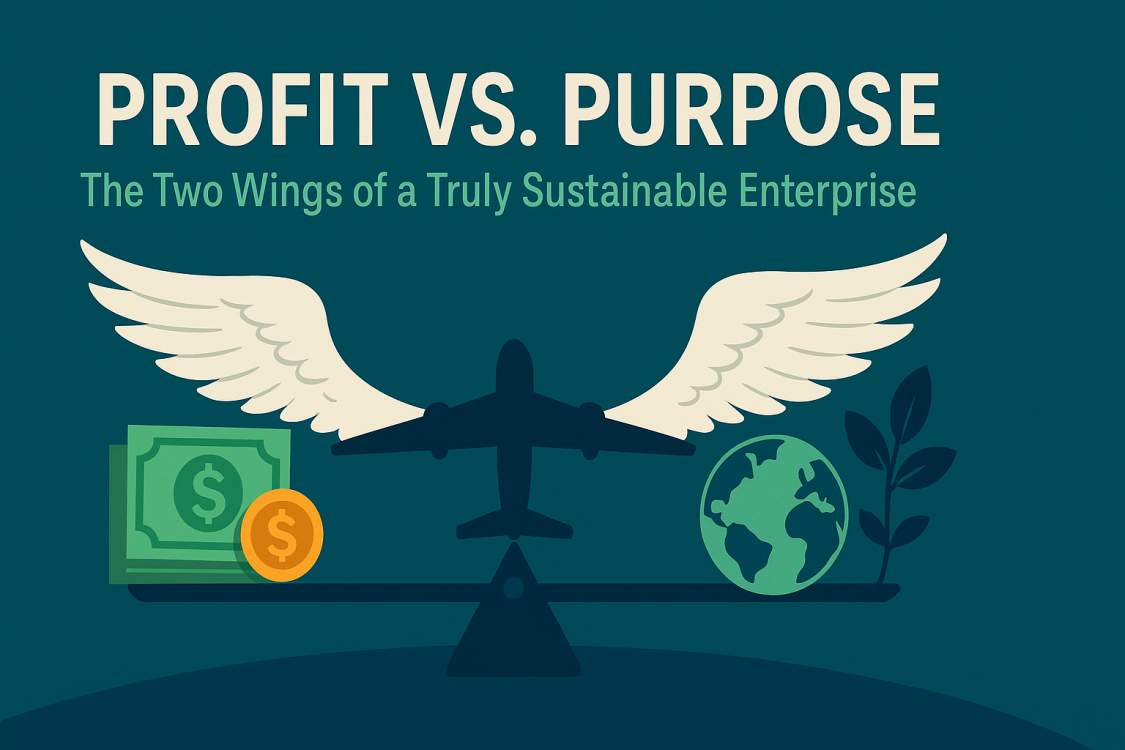
Sustainable growth doesn’t come from profits alone. It comes from balancing profit with purpose—treating both as equally critical wings of your enterprise.
Why Purpose Isn’t Just Feel-Good Philosophy
Purpose isn’t about corporate social responsibility campaigns or mission statements on walls. It’s about the fundamental reason your business exists beyond making money.
Here’s what purpose actually delivers:
It Unlocks Discretionary Effort
Employees who understand the meaningful impact of their work don’t just show up—they give their best. They solve problems proactively. They stay longer. They become advocates, not just workers.
It Creates Unshakeable Brand Trust
Customers forget products. They remember businesses that create genuine impact. In crowded markets, purpose becomes your most powerful differentiator—one that can’t be copied or undercut.
It Fuels True Innovation
When you’re solving meaningful problems, creativity flows naturally. Teams innovate not because they’re told to, but because they’re genuinely invested in finding better solutions.
It Builds Adaptive Resilience
Purpose-driven companies navigate market disruptions better. Why? Because they’re anchored to something deeper than quarterly results. When tactics must change, their strategic north star remains clear.
The insight most founders miss: purpose doesn’t compete with profit—it multiplies it.
The Five-Step Purpose-Profit Framework
Step 1: Define Your Core Purpose
Go beyond what you sell to why it matters. Ask yourself:
- What fundamental problem are we solving?
- Whose lives are we improving, and how?
- If we disappeared tomorrow, what would be lost?
Your purpose should be specific enough to guide decisions but broad enough to allow growth.
Step 2: Measure What Matters Beyond Revenue
Expand your dashboard to include:
- Customer satisfaction and retention rates
- Employee growth and development metrics
- Net Promoter Score and referral patterns
- Social or environmental contribution indicators
- Innovation velocity and problem-solving capacity
What gets measured gets managed. If you only track revenue, you’ll only optimize for revenue.
Step 3: Apply the Dual-Filter Decision Test
Before any strategic move, ask two questions:
- Does this improve our financial position?
- Does this advance our purpose?
The best decisions score high on both. Avoid moves that sacrifice one for the other unless absolutely necessary—and when you must choose, understand the trade-off explicitly.
Step 4: Communicate With Radical Clarity
Your purpose means nothing if it lives only in your head. Share it consistently:
- With your team during onboarding, meetings, and performance reviews
- With customers through your marketing, service, and interactions
- With partners and suppliers as the foundation of collaboration
Alignment breeds loyalty. Clarity breeds collective energy. Silence breeds confusion.
Step 5: Conduct Quarterly Purpose-Profit Reviews
Every quarter, evaluate honestly:
- Are we growing financially?
- Are we creating meaningful impact?
- Where are we out of balance?
- What adjustments do we need?
This prevents mission drift and profit obsession—the two most common paths to failure.
The MSME Founder Reality Check
In the MSME space, chasing profits alone feels like sprinting on a treadmill—exhausting motion without meaningful progress.
You close deals but lose team members. You hit targets but sacrifice relationships. You grow revenue but erode trust. Eventually, the treadmill wins.
When founders consciously integrate purpose, everything shifts. Every sale becomes more than a transaction. Every decision carries strategic weight. Every interaction builds toward something larger.
Profit stops being the goal. It becomes the natural byproduct of doing the right things consistently.
The Perception Shift That Changes Everything
Here’s the reframe that separates sustainable businesses from struggling ones:
Profit is the reward. Purpose is the compass.
Profit tells you if you’re executing well. Purpose tells you if you’re heading in the right direction.
Leaders who master both dimensions make decisions that balance short-term returns with long-term sustainability. They build businesses that don’t just survive market changes—they thrive through them.
They attract better talent. They command premium pricing. They create customer loyalty that competitors can’t poach with discounts. They sleep better because their success rests on solid foundations, not just quarterly luck.
Your Action Item This Week
Evaluate a recent significant business decision through the dual lens:
Step 1: Choose one major decision you made in the last month (a new hire, a product launch, a partnership, a pricing change).
Step 2: Rate its impact on two scales (1-10):
- Profit Impact: Did this improve our financial position?
- Purpose Impact: Did this advance our core mission and values?
Step 3: Reflect on the results:
- If both scores are high (7+): This is your model for future decisions
- If one is high and one is low: What would it take to balance them?
- If both are low: Why did you make this decision, and what needs to change?
Step 4: Commit to applying this dual-filter test to your next three major decisions.
The Bottom Line
Sustainable businesses aren’t built on profit maximization or purpose alone. They’re built on dual mastery—the disciplined integration of earning and meaning.
Think of your business as a bird. One wing is profit—the practical engine that keeps you airborne. The other wing is purpose—the directional force that determines where you’re flying.
Try to fly with one wing, and you’ll spin in circles. Master both, and you don’t just survive the journey—you soar.
The question isn’t whether to choose profit or purpose. The question is: Are you ready to build a business that delivers both?
Next week: Building Systems That Work When You Don’t—Delegation Without Losing Control
The Perception Insights Newsletter
By Vinod C. Pandita, Founder & CEO @ Perception Management Consulting Pvt. Ltd.