-
PX Consulting
- December 8, 2025
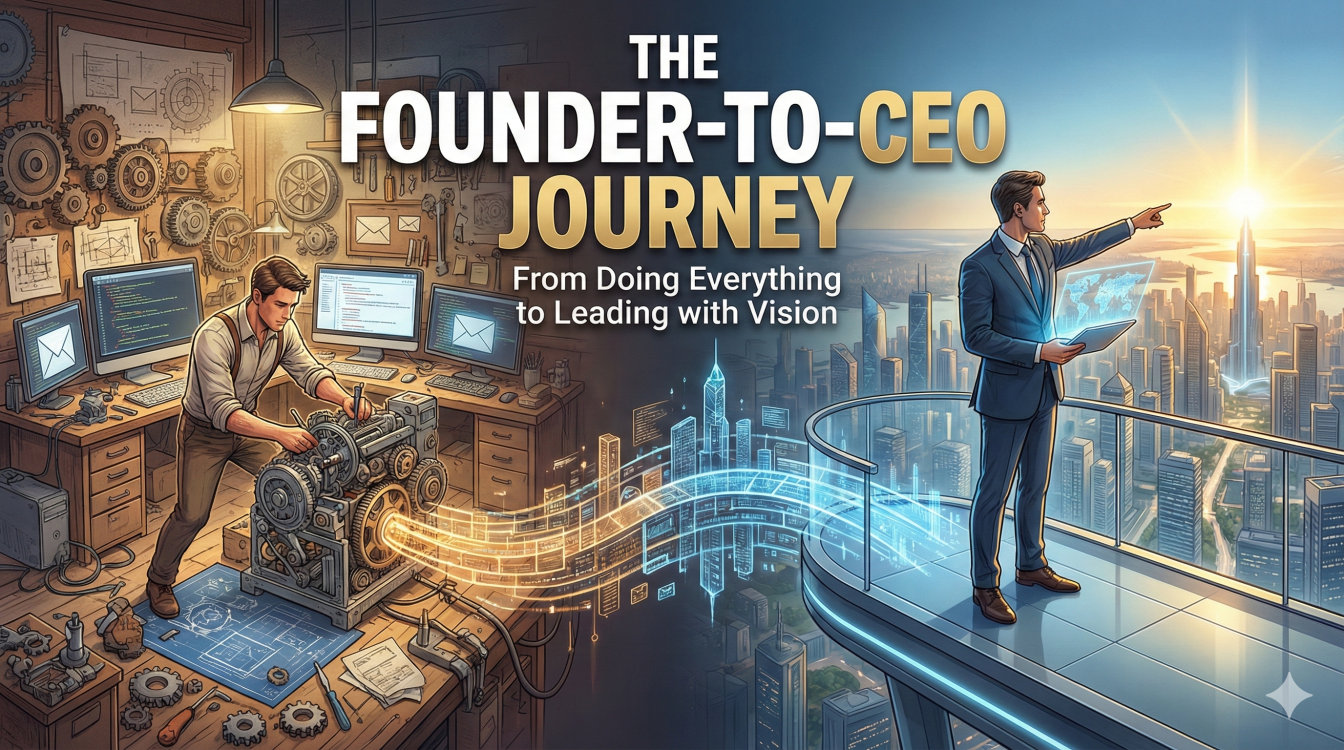
Every founder starts with fire, energy, and a relentless drive to do it all. You write the emails, handle client calls, manage operations, and even solve HR issues personally. This hands-on approach fuels early momentum and gets the business off the ground.
But here’s the paradox: the very instincts that help you launch can become the ceiling that limits your growth. The transition from Founder to CEO isn’t about working harder or longer—it’s a fundamental shift in how you perceive your role and prioritize your time.
Why Most Founders Struggle to Make the Shift
The founder-to-CEO transition is one of the most challenging inflection points in building a business. Several deeply ingrained patterns hold founders back:
Attachment to Execution. You’ve built the business through your own hands. You know you can complete tasks faster and better than anyone else. This expertise becomes a trap—every problem looks like something only you can solve.
Fear of Delegation. Letting go means accepting imperfection. What if someone makes a costly mistake? What if quality suffers? This fear keeps founders tethered to operational details long after they should have moved on.
Absence of Systems. Without clear processes, frameworks, and accountability structures, delegation feels like gambling. The business runs on institutional knowledge stored in your head, making it nearly impossible to transfer responsibilities effectively.
Short-Term Pressure. Daily fires demand immediate attention. Client emergencies, cash flow concerns, and team conflicts create a constant state of urgency that crowds out strategic thinking. The urgent always trumps the important.
This mindset keeps founders trapped in the day-to-day grind, unable to scale their vision or lead with the perspective the business truly needs.
The Founder-to-CEO Framework
Making this transition requires intention and structure. Here’s a practical framework to guide your evolution:
Define Your CEO Role. Start by clarifying what only you can do. Your highest-value contributions center on vision-setting, strategic decision-making, culture-building, and developing key relationships. Everything else is a candidate for delegation. Write down your CEO job description and refer to it when evaluating how you spend your time.
Map Your Responsibilities. Conduct an honest audit of where your time actually goes. Categorize every responsibility into four buckets: must own personally, can delegate immediately, requires training before delegating, and should eliminate entirely. This clarity creates your roadmap.
Build Leadership Layers. Scaling requires distributing decision-making authority. Identify or develop leaders who can own functional areas with minimal oversight. Establish clear decision-making boundaries—what they can decide independently, what requires consultation, and what needs your approval. Trust grows through successful delegation cycles.
Implement Outcome-Based Accountability. Shift from tracking activities to measuring results. Weekly or bi-weekly checkpoints should focus on outcomes achieved, obstacles encountered, and support needed. This approach respects autonomy while maintaining alignment.
Protect Time for Strategic Thinking. Block dedicated time—weekly at minimum—for reflection, learning, and future-planning. This isn’t optional; it’s the work that separates maintaining a business from building something enduring. Use this time to ask: Where are we headed? What’s changing in our market? What capabilities do we need to build?
The MSME Reality
Many small and mid-sized businesses stagnate because founders never make this transition. The business grows only as fast as the founder can personally manage—a human constraint on what could be exponential growth.
By embracing the CEO mindset, you unlock multiplicative leverage. Your time, talent, and impact expand beyond your personal capacity. You build an organization that generates value through systems and people, not just through your individual effort.
The Perception Shift
At its core, the journey from founder to CEO is a shift in perception—from controller to architect, from doer to enabler, from soloist to conductor.
It requires seeing the business as a system where your role is to design, guide, and elevate rather than micromanage every detail. You move from being indispensable to making yourself deliberately dispensable in operations, which paradoxically makes you more valuable in strategy.
This shift isn’t about abandoning your strengths or disconnecting from the work. It’s about channeling your energy where it creates the greatest impact. As the ancient principle reminds us: chase two rabbits at once and you’ll catch neither. The CEO mindset helps you focus on the few things that matter most.
Action for This Week
Take thirty minutes for this exercise:
List every task you personally handled last week. Be comprehensive—include emails, meetings, decisions, and problem-solving.
Now identify three items that someone else could own with proper context and clear success criteria. These should be meaningful responsibilities, not just busy work.
Delegate these three items this week. Provide clear outcomes, necessary resources, and a feedback loop. Use the reclaimed time for strategic thinking, mentorship, or innovation—the high-leverage work that only you can do.
Building a Business That Scales
Founders create. CEOs multiply.
By shifting from doing to leading, you build a business that works with you, not because of you. You create space to focus on vision, growth, and legacy rather than drowning in the tactical details of today.
The businesses that transcend their founders all share this common thread: at some point, the founder made the conscious choice to evolve. They recognized that their greatest contribution wasn’t their technical skill or work ethic—it was their ability to build something larger than themselves.
That evolution starts with a single decision: to lead differently. The question isn’t whether you can make this shift. The question is whether you’re willing to begin.
The Perception Insights Newsletter
By Vinod C. Pandita, Founder & CEO @ Perception Management Consulting Pvt. Ltd.