-
PX Consulting
- December 30, 2025
Every founder starts as the indispensable expert. You know every client, every process, every decision. You’re the only one who can solve the complex problems, handle the difficult conversations, and make things work. This knowledge makes you powerful. It also makes you the ceiling.
The moment your business depends entirely on you is the moment it stops being scalable. You become the bottleneck, the single point of failure, the constraint that prevents growth. Your expertise, which built the business, now limits it.
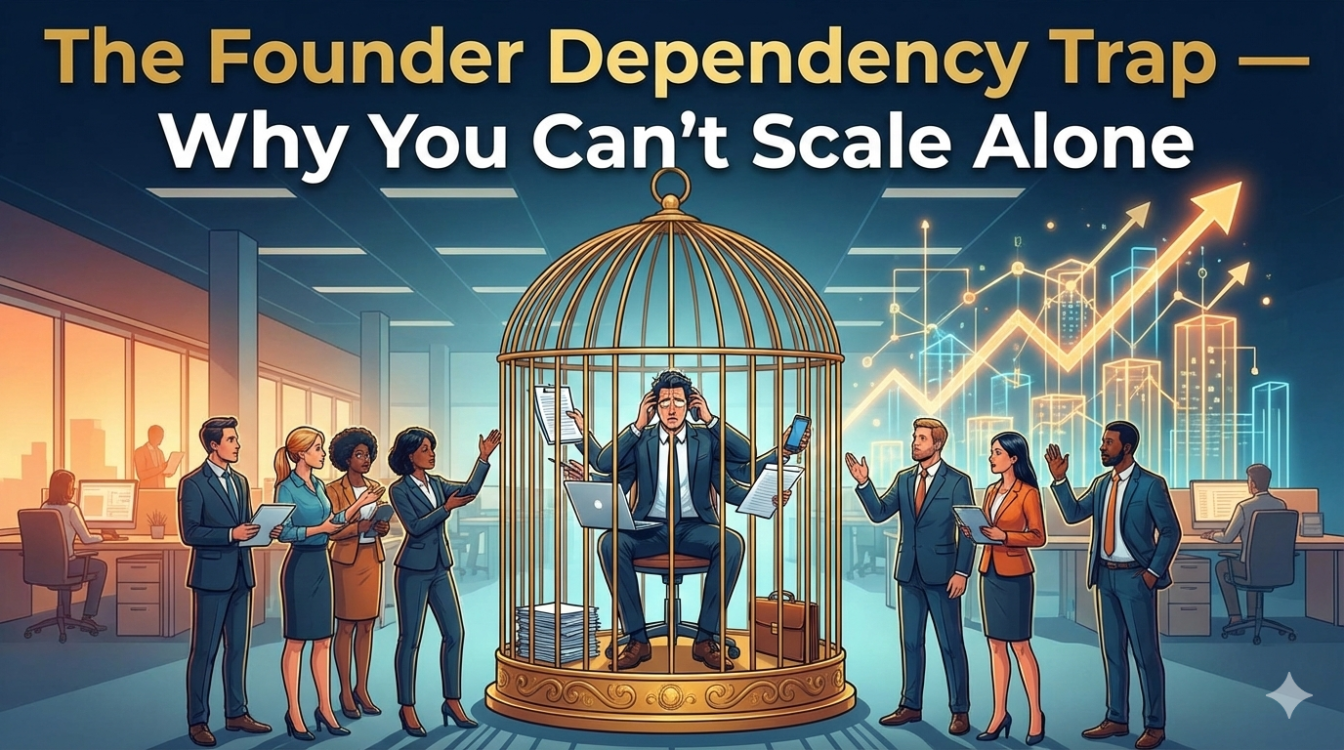
This is the founder dependency trap. And most MSMEs never escape it.
The Invisible Prison
Here’s what founder dependency looks like in practice: You can’t take a vacation without the business grinding to a halt. Your team asks for approval on decisions they should be making independently. Critical processes exist only in your head. When clients have problems, they demand to speak with you personally.
You’ve built a business that works only when you’re present, alert, and available. The moment you step back, things fall apart. This isn’t strength—it’s fragility disguised as indispensability.
The trap is seductive because it feels productive. You’re busy, you’re solving problems, you’re making things happen. But you’re not building a business. You’re building a job that requires your constant presence. And that job has an expiration date—your own capacity.
Why Processes Live in Your Mind
Most founders never formalize what they know because it feels unnecessary. “I know how to do it, so why write it down?” This logic works when the business is small and simple. It collapses the moment you try to grow.
Here’s what happens: You hire someone to help. You explain the process once, maybe twice. They do it wrong. You fix it. They do it wrong again. Eventually, you conclude they’re incompetent and do it yourself. The cycle repeats with every new hire.
The problem isn’t the people. It’s the absence of systems. Without documented processes, institutional knowledge, and clear standards, every task becomes dependent on your personal involvement. Your team isn’t failing—they’re navigating ambiguity with no map.
Processes living in your mind create several cascading problems. First, training becomes inefficient and inconsistent. Every new team member learns differently based on what you remember to tell them. Second, quality becomes unpredictable because there’s no standard to follow. Third, delegation becomes impossible because you can’t transfer something that only exists in your head.
The result? You remain the only person who can do things correctly. The business scales only as much as your personal capacity allows. Growth becomes exhausting rather than exciting.
The Cost of Being Indispensable
Founder indispensability carries hidden costs that compound over time. Let’s examine them:
Strategic Blindness: When you’re buried in operations, you can’t see the bigger picture. You miss market shifts, competitive threats, and growth opportunities because you’re too busy managing daily tasks. Strategic thinking requires space that indispensability eliminates.
Team Stagnation: Your team stops developing because they never own anything meaningful. They become order-takers rather than problem-solvers. The best people leave because they’re not growing. Those who stay become dependent on your direction for everything.
Business Risk: What happens if you get sick? Have a family emergency? Simply burn out? The business has no resilience. Your personal circumstances become business existential threats. This fragility terrifies investors, limits valuation, and prevents exit opportunities.
Growth Ceiling: You can only serve as many clients, manage as many projects, or make as many decisions as your time allows. The business hits a hard ceiling equal to your personal capacity. Breaking through requires working more hours—a temporary solution that leads to burnout.
Decision Fatigue: Making every decision, solving every problem, and reviewing every output drains your energy and judgment. By the end of each day, you’re making poor choices simply because your decision-making capacity is depleted.
The irony is cruel: the very knowledge and skills that made you successful become the chains that prevent scaling.
The Breaking Point Between Small Business and Scalable Company
The difference between a small business and a scalable company isn’t revenue size or employee count. It’s whether the business can function and grow without the founder’s constant involvement.
Small businesses are founder-dependent. They’re extensions of the founder’s expertise, working as long as the founder works. Scalable companies are system-dependent. They’re built on processes, roles, and standards that enable operations without founder micromanagement.
This transition requires three fundamental shifts:
1. Building Standard Operating Procedures (SOPs)
SOPs are the documented playbooks that encode your expertise into repeatable processes. They answer the question: “How do we do this task correctly, consistently, every time?”
Most founders resist creating SOPs because it feels tedious and time-consuming. But here’s the reality: every time you personally do a task that could be delegated, you’re choosing short-term efficiency over long-term scalability. Writing the SOP takes time once. Doing the task yourself costs time forever.
Start with high-frequency, high-impact activities. What tasks do you or your team perform repeatedly? What processes directly affect customer satisfaction or revenue? Document these first.
Make SOPs simple and actionable. Use step-by-step instructions, screenshots, checklists, and decision trees. Write for someone who knows nothing about the task. Include the why behind each step, not just the what. Understanding context improves compliance and enables adaptation.
Treat SOPs as living documents. Processes evolve. Markets change. Tools improve. SOPs should be updated regularly based on team feedback and operational learning. Assign ownership—someone responsible for keeping each SOP current and effective.
Test your SOPs. Have someone unfamiliar with the process follow the SOP without your help. Where do they get stuck? What’s unclear? Revise until the SOP enables independent execution.
The goal isn’t bureaucracy. It’s consistency. SOPs ensure that your standards are maintained whether you’re present or not, whether the task is done by a veteran or a new hire.
2. Delegation Systems That Actually Work
Delegation isn’t dumping tasks on people and hoping for the best. Effective delegation is a system that transfers responsibility, authority, and accountability while maintaining quality.
Most founders fail at delegation because they confuse it with abdication. They either micromanage every detail (defeating the purpose) or give vague instructions and disappear (ensuring failure). Real delegation requires structure.
Define outcomes, not activities. Instead of “send these emails,” say “ensure all clients receive their monthly reports by the 5th with less than 2% error rate.” Outcome-based delegation gives autonomy while maintaining accountability.
Match tasks to capabilities. Not every task can be delegated to anyone. Assess team skills honestly. Delegate tasks slightly beyond current comfort zones to enable growth, but not so far beyond that failure is guaranteed.
Provide context and constraints. Explain why the task matters, how it fits into larger goals, and what success looks like. Define boundaries—budget limits, approval requirements, decision authority. Clarity prevents confusion and enables confident action.
Create feedback loops. Schedule regular check-ins, not to micromanage but to provide support, answer questions, and catch issues early. Initially, these should be frequent. As competence grows, reduce frequency.
Accept imperfection. Your team won’t do things exactly as you would. That’s fine. Focus on whether outcomes meet standards, not whether methods match your preferences. Perfectionism kills delegation.
Celebrate ownership. When someone successfully completes delegated work, acknowledge it. When they improve on your approach, praise it. Building confidence and ownership in your team accelerates the transition from dependence to autonomy.
3. Role Clarity and Organizational Structure
Growth without structure creates chaos. Everyone does a little of everything, accountability is fuzzy, and decisions get made (or don’t) through informal conversations and assumptions.
Define clear roles. What is each person responsible for? What decisions can they make independently? What requires consultation or approval? Role clarity eliminates confusion and empowers action.
Create decision-making frameworks. Not every decision needs your input. Categorize decisions into three tiers: those your team can make independently, those requiring consultation, and those requiring approval. Make these frameworks explicit and train your team to use them.
Build functional ownership. As you grow, people need to own entire functions—sales, operations, finance, delivery. Functional ownership means someone is accountable for results, has authority to make decisions, and owns the processes within their domain.
Establish communication rhythms. Regular meetings, reports, and updates create predictability and ensure alignment without constant firefighting. Weekly team meetings, monthly business reviews, quarterly planning sessions—structure creates scalability.
Document your organizational structure. Who reports to whom? Who owns what? Make it visible. Org charts aren’t bureaucratic formalities—they’re clarity tools that help everyone understand how the business operates.
The Transition: From Doer to Leader
Escaping the founder dependency trap requires a fundamental identity shift. You must evolve from the person who does the work to the person who builds the systems that enable others to do the work.
This transition is uncomfortable. It feels slower initially because you’re documenting instead of doing. It requires patience because teaching takes longer than completing tasks yourself. It demands humility because others will do things differently than you would.
But this discomfort is the price of scale. Every hour spent building systems is an hour invested in future capacity. Every process documented is a piece of your expertise that no longer requires your presence. Every person successfully empowered is expansion of your business capability.
Start small but start now. Pick one critical process this week. Document it. Create an SOP. Train someone to own it. Delegate it completely. Resist the urge to take it back when they stumble. Coach, refine the SOP, and let them own it.
Then repeat. Next week, another process. Next month, another functional area. Gradually, systematically, you build a business that operates through systems rather than your personal involvement.
The MSME Reality: Most Never Make This Shift
Walk through any business district and you’ll see countless MSMEs trapped in founder dependency. The business works, generates revenue, even provides decent income. But it can’t grow because it’s built on the founder’s shoulders rather than on systems.
These businesses have an expiration date. When the founder retires, burns out, or faces personal crisis, the business collapses. All that knowledge, all those relationships, all that expertise—lost because it lived in one person’s mind rather than in systems.
The businesses that break through understand this reality. They deliberately invest in becoming systematized, documented, and transferable. They build organizations that work not because the founder is brilliant, but because the systems are sound.
Your Choice: Bottleneck or Architect
You face a choice. You can remain the indispensable expert, the person who knows everything and does everything. Your business will grow to the limits of your personal capacity and stop there. You’ll work harder every year for incremental gains. You’ll never escape the operational grind.
Or you can become the architect. The person who builds systems, develops people, and creates scalable processes. Your business will grow beyond your personal capacity. You’ll work on strategic priorities rather than operational details. You’ll build something that lasts beyond your direct involvement.
The founder dependency trap is comfortable. It feels productive, important, necessary. But it’s a prison that prevents the very growth you’re working so hard to achieve.
Breaking free requires deliberate choice. Document your processes. Build delegation systems. Create role clarity. Transform your expertise from personal knowledge into institutional capability.
The question isn’t whether you can escape the trap. The question is whether you’re willing to do the uncomfortable work required to build a business that scales beyond you.
Your business doesn’t need you to be indispensable. It needs you to make yourself dispensable in operations so you can become invaluable in strategy.
That’s the difference between being a founder and being a CEO. That’s the difference between running a small business and building a scalable company.
The choice is yours. But the clock is ticking. Every day you remain the bottleneck is a day your business stays trapped in the founder dependency cage.
The Perception Insights Newsletter
By Vinod C. Pandita, Founder & CEO @ Perception Management Consulting Pvt. Ltd.