-
PX Consulting
- February 10, 2026
The MSME Talent Paradox
You need exceptional people to grow your business, but you can’t match the salaries offered by large corporates or well-funded startups. If this resonates with you, you’re facing one of the most common—and most solvable—challenges in the MSME sector.
The solution isn’t about matching Big Corp salaries. It’s about understanding what truly drives talented professionals and building a compelling value proposition around those drivers.
The Salary Myth: Why Money Isn’t Everything
Let’s address the elephant in the room: salary matters. Anyone who tells you otherwise is either lying or disconnected from reality. But here’s the critical insight most MSME founders miss: salary is a hygiene factor, not a motivator.
The Data Tells a Different Story:
- 67% of employees leave for reasons other than salary
- 58% value growth opportunities over higher pay
- 72% would take a pay cut for better work-life balance
What does this mean for your MSME? If your salary is within a reasonable range of market standards (even if it’s 10-20% below large corporates), you can still attract and retain top talent by excelling in other areas that matter deeply to professionals.
Key Insight: The Total Compensation Equation
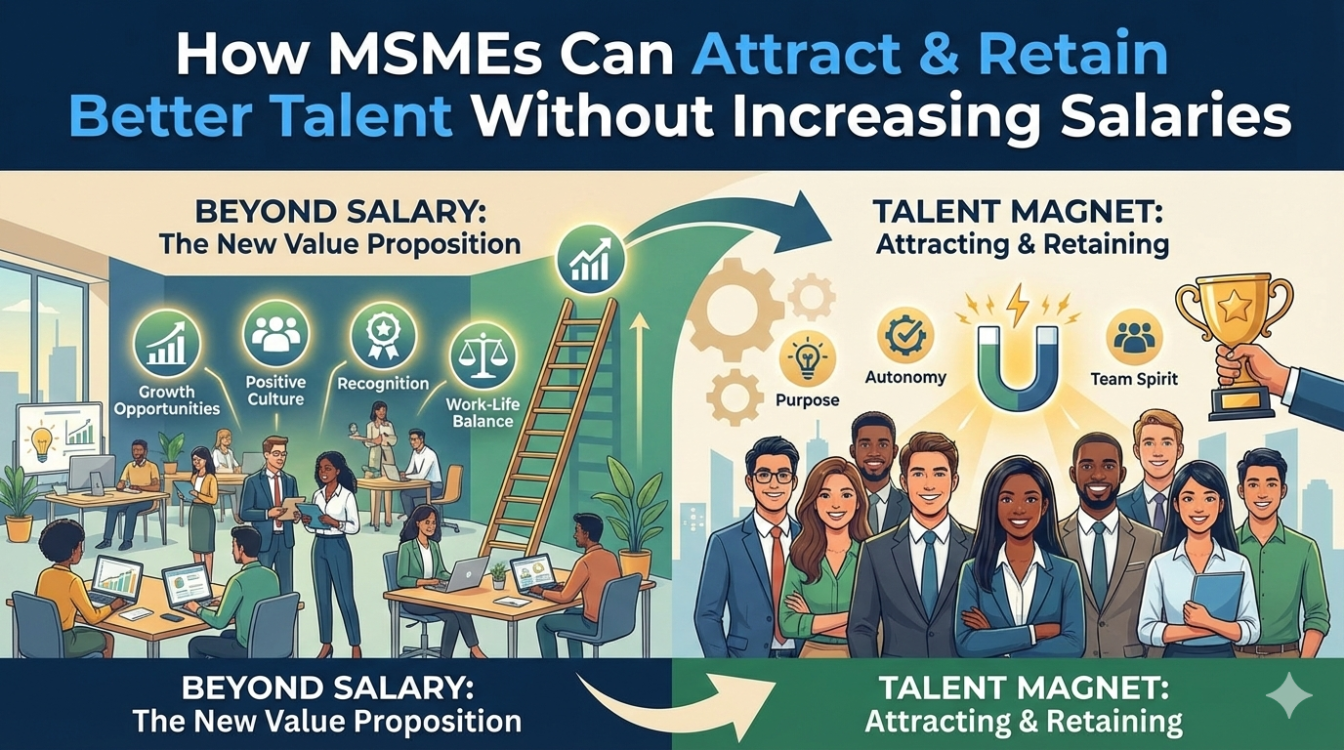
Total Value = Salary + Growth + Culture + Purpose + Autonomy + Recognition
If you can’t maximize the first variable (salary), you must excel at the others. And here’s the surprising truth: many talented professionals will trade cash for the right combination of the other factors.
Strategy 1: Offer Disproportionate Growth Opportunities
Large corporates have structured career ladders, but they also have bureaucracy, politics, and slow decision-making. MSMEs can offer something big companies rarely can: accelerated growth and expanded responsibilities.
Why This Works
Talented professionals, especially those in their 20s and 30s, are hungry for experience that advances their careers. They know that three years of high-impact, cross-functional responsibility at a dynamic MSME can be worth more than five years of narrow specialization at a large corporation.
How to Implement This:
1. Create Individual Development Plans (IDPs) Within the first month, sit with every new hire and map a personalized 18-24 month growth roadmap. Define specific skills they’ll acquire, responsibilities they’ll own, and outcomes they’ll achieve. This isn’t corporate HR theater—it’s a genuine commitment to their growth.
2. Fast-Track High Performers In large companies, promotion cycles are rigid (18-24 months minimum). In your MSME, create a culture where exceptional performance is rewarded with expanded scope within 6-9 months, not 2-3 years. Make merit-based progression visible and real.
3. Cross-Functional Exposure Let your marketing hire shadow sales conversations. Let your operations person join strategic planning meetings. Allow your finance analyst to participate in client negotiations. MSMEs can offer breadth of experience that corporates structurally cannot match.
4. Leadership Opportunities Early A 27-year-old can lead a project, manage a small team, or own a business vertical in your MSME. The same person would be an “associate” doing narrow tasks at a corporate for another five years. This time advantage is invaluable for ambitious professionals.
Real-World Example: A manufacturing MSME in Pune couldn’t match the ₹12L salary a promising MBA graduate received from a consulting firm. They offered ₹8.5L but with this proposition: “In 18 months, you’ll lead a complete business unit, manage P&L, and own vendor negotiations for our ₹25 crore product line. At the consulting firm, you’ll be making PowerPoint slides for partners.”
The candidate chose the MSME. Two years later, they were heading a division and earning ₹15L—with experience that made them a VP candidate elsewhere.
Strategy 2: Build a Culture of Ownership & Autonomy
Corporate employees often describe feeling like “cogs in a machine.” MSMEs can offer something fundamentally different: a sense of ownership, voice, and impact.
The Autonomy Advantage
When people feel they own their work—when their ideas matter, when they can make decisions without endless approvals, when they see direct impact—they become emotionally invested. This emotional investment is more powerful than a 20% salary bump.
How to Implement This:
1. Flatten the Hierarchy Eliminate unnecessary approval layers. If your operations manager needs founder approval for a ₹15,000 decision, you’re killing autonomy. Set clear spending limits and decision-making authority. Trust your people.
2. Implement “Ownership Thinking” Stop assigning tasks. Start assigning outcomes. Instead of “Create this report,” say “Figure out why our customer retention dropped 8% last quarter and propose solutions.” Let them own the problem, not just the task.
3. Transparent Communication Share business financials, strategic challenges, and key decisions with your team. When people understand the “why” behind decisions, they feel trusted and valued. Monthly business updates with real numbers build belonging.
4. Idea Meritocracy Create formal mechanisms for employees to pitch ideas—whether it’s a weekly “innovation hour” or a monthly strategy session. When a junior employee’s idea gets implemented and they receive recognition, it creates a culture where contribution matters more than hierarchy.
The Founder Accessibility Factor
In your MSME, employees can walk into the founder’s office and have a real conversation. They can influence strategy. They’re not 15 layers removed from decision-making. This proximity to leadership is incredibly valuable to ambitious professionals who want to learn and grow.
Strategy 3: Invest in Continuous Learning & Skill Development
If you can’t pay top-of-market salaries, invest in making your people more valuable. Professionals understand that skills compound over a career. An MSME that genuinely develops talent becomes a launch pad, not a dead end.
How to Implement This:
1. Learning Budgets Allocate ₹25,000-₹50,000 per employee annually for courses, certifications, workshops, or conferences. Let them choose based on their development goals. This shows you’re investing in their future, not just extracting value.
2. Bring in External Experts Quarterly, invite industry experts, consultants, or trainers for skill-building sessions. This costs a fraction of salary increases but shows genuine investment. A ₹50,000 workshop for 10 people costs ₹5,000 per head but creates significant perceived value.
3. Mentorship Programs If you have senior professionals internally, formalize mentorship. If not, create external mentor connections through your network. Guidance from experienced professionals is often more valuable than a salary bump for career trajectory.
4. Project-Based Learning Assign stretch projects that force skill acquisition. Someone who successfully leads a digital transformation project gains skills worth lakhs in market value—even if you can’t immediately pay them accordingly.
5. Sponsorship for Certifications Pay for industry certifications (CFA, PMP, Six Sigma, Digital Marketing certifications, etc.). These credentials increase an employee’s market value, but loyalty follows when you sponsor their growth.
Strategy 4: Offer Flexibility & Work-Life Integration
Post-pandemic, flexibility has become non-negotiable for many professionals. MSMEs can be far more agile than large corporates in offering flexible work arrangements.
Why This Matters
A parent who can pick up their child from school at 3 PM without guilt. A professional who can work remotely two days a week. Someone who can start early and leave early. These lifestyle benefits often outweigh incremental salary increases.
How to Implement This:
1. Flexible Work Hours Move from “9-6 mandatory” to “core hours + output-based evaluation.” As long as work gets done and collaboration isn’t hampered, flexibility in timing creates immense goodwill.
2. Hybrid Work Models If your business allows, offer 2-3 days remote work per week. This saves commute time (2-3 hours daily in metros) and reduces stress—worth thousands of rupees in perceived value.
3. Results-Oriented Work Environment (ROWE) Evaluate people on outcomes, not hours logged. If someone completes their deliverables in 6 focused hours instead of 9 distracted hours, celebrate efficiency rather than penalize “early leaving.”
4. Personal Emergency Leave Don’t count every doctor’s appointment or family emergency against leave balances. Build trust by allowing reasonable personal time without bureaucratic leave applications.
The Perceived Value: A professional who saves 2 hours of commute daily (10 hours/week, 40 hours/month) values this as equivalent to ₹30,000-₹50,000 monthly in quality of life—especially if they have young children or aging parents.
Strategy 5: Create Purpose & Meaningful Work
Talented professionals increasingly want work that matters. They want to feel they’re building something, not just processing transactions.
The Purpose Premium
People will accept lower salaries if they believe their work creates genuine impact—whether that’s building a meaningful product, serving underserved markets, or being part of a mission-driven organization.
How to Implement This:
1. Articulate Your Mission Clearly Why does your MSME exist beyond profit? Are you solving a real problem? Serving a community? Building something innovative? Communicate this consistently.
2. Connect Daily Work to Larger Outcomes Help employees see how their individual contributions connect to customer impact or business outcomes. The person processing invoices should understand how their accuracy enables timely vendor payments that strengthen supply chain relationships.
3. Customer Connection Let employees interact with customers directly. When they hear customer appreciation or see how your product/service improves lives, work becomes meaningful rather than transactional.
4. Social Responsibility Initiatives If your MSME supports community programs, environmental initiatives, or social causes, involve employees. Purpose-driven work creates emotional bonds money can’t buy.
Strategy 6: Recognition & Appreciation (Beyond Cash)
Humans crave recognition. Consistent, genuine appreciation costs nothing but creates loyalty that salary increases alone cannot achieve.
The Recognition Gap in Most Organizations
Most founders assume “salary is the recognition.” Wrong. People want to be seen, valued, and appreciated for their specific contributions. Public recognition often matters more than private bonuses.
How to Implement This:
1. Public Acknowledgment In team meetings, highlight specific contributions: “Priya’s customer retention strategy saved us 3 accounts worth ₹15L this quarter.” Be specific, be public, be genuine.
2. Founder Appreciation Notes A handwritten note or personalized email from the founder recognizing someone’s exceptional work creates emotional impact. This costs zero rupees but is remembered for years.
3. Responsibility as Reward Give high performers more meaningful responsibilities. Often, being trusted with a critical project is more motivating than a cash bonus.
4. Celebration of Wins When the team achieves milestones, celebrate. Team lunches, small outings, or even public shout-outs create culture and belonging.
5. Career Storytelling Share employee success stories internally and externally (with permission). Feature team members in company communications, LinkedIn posts, or case studies. Visibility builds pride.
Strategy 7: Build Genuine Relationships & Team Culture
People don’t leave jobs—they leave managers and toxic cultures. Conversely, people stay in organizations where they have genuine friendships and feel psychologically safe.
The Culture Multiplier
A strong, supportive culture creates retention that salary alone cannot. When someone feels they belong, when they have genuine work friendships, when Monday mornings aren’t dreaded—they’re less likely to leave for a 15% raise.
How to Implement This:
1. Invest in Team Building Not forced “trust falls” but genuine relationship-building. Quarterly team outings, monthly team lunches, or even informal Friday catch-ups matter.
2. Create Psychological Safety Build an environment where people can speak up, disagree, make mistakes, and ask questions without fear. When people feel safe to be themselves, they stay.
3. Celebrate Personal Milestones Birthdays, work anniversaries, personal achievements (marathons, certifications, family celebrations)—acknowledge them. When work feels like community, retention follows.
4. Conflict Resolution Address interpersonal conflicts quickly and fairly. Toxic relationships drive talent away faster than low salaries. Protect culture ruthlessly.
Strategy 8: Equity & Profit-Sharing (When Appropriate)
If cash salary is constrained, consider sharing ownership or profits. This aligns incentives and creates long-term commitment.
Equity/ESOP Options
For growth-oriented MSMEs, offering small equity stakes (0.1%-2% for key employees) can be transformative. When employees are owners, their mindset shifts from “job” to “building something together.”
Profit-Sharing Models
Alternatively, create transparent profit-sharing formulas. Example: “15% of annual profits above ₹X target will be distributed among the team based on performance ratings.”
Important: Only implement if you’re willing to share financials transparently. Half-hearted or opaque profit-sharing creates cynicism, not loyalty.
Strategy 9: Hire for Alignment, Not Just Skills
This is preventative retention. Hire people who value what you offer, not those purely chasing maximum salary.
How to Identify the Right Candidates:
1. In Interviews, Discuss What Matters to Them Ask: “What frustrated you about your last role?” or “If you could design your ideal work environment, what would it include?” Listen for alignment with your strengths (growth, autonomy, flexibility).
2. Be Transparent About Salary Positioning Don’t hide that you’re below Big Corp salaries. Instead, be upfront: “We can’t match Google’s pay, but here’s what we offer instead…” Candidates who stay after that conversation are aligned.
3. Look for Growth-Oriented Candidates Hire people who explicitly prioritize learning, responsibility, and career trajectory over maximizing current salary. They exist—you just need to filter for them.
4. Reference Checks for Culture Fit Ask references: “Did this person thrive with autonomy or need structure?” You want self-starters who flourish in MSME environments.
Strategy 10: Address Hygiene Factors (Non-Negotiables)
Even with all the above strategies, certain basics cannot be ignored:
Competitive Baseline: Your salary should be within 15-20% of market rates. If you’re 40% below, no amount of “culture” will compensate. Use salary surveys to benchmark.
Health Insurance & Benefits: Provide comprehensive health coverage for employees and their families. Medical emergencies create financial stress that undermines all other retention efforts.
Timely Salary Payments: Never, ever delay salaries. This single failure destroys trust faster than anything else.
Safe, Comfortable Work Environment: Clean workspace, functional equipment, good lighting, safe commute. Basic dignity matters.
Clear Expectations: Ambiguity creates anxiety. People need to know what success looks like in their role.
Putting It All Together: The MSME Talent Value Proposition
Here’s how to articulate your offer to prospective hires:
“We can’t match corporate salaries, but here’s what we offer instead:
- Accelerated Growth: You’ll own significant responsibility within 12-18 months that would take 4-5 years elsewhere
- Direct Impact: Your work directly influences business outcomes; you’re not a cog in a machine
- Learning Investment: ₹40,000 annual learning budget plus quarterly expert sessions
- Flexibility: Hybrid work model (3 days office, 2 days remote) and flexible hours
- Founder Access: You’ll work directly with leadership and influence strategy
- Ownership Culture: We trust you to make decisions and own outcomes
- Transparent Environment: You’ll see business financials and understand the ‘why’ behind decisions
Sound appealing? We thought so. Let’s talk.”
The Long-Term Perspective: Building a Talent Brand
As you implement these strategies consistently, something powerful happens: you build a reputation as a great place to work. Your alumni become your advocates. People hear that “XYZ Company doesn’t pay the most, but they genuinely develop talent.”
This reputation attracts candidates who align with your values. Over time, you spend less energy “convincing” people to join because your culture precedes you.
Common Mistakes to Avoid
1. Talking the Talk Without Walking the Walk Don’t promise growth, autonomy, and learning if you’re not genuinely committed. Broken promises create turnover faster than low salaries.
2. Treating These Strategies as “Cheap Labor Tactics” If your mindset is “How do I pay less and extract more?” it will show. These strategies work when you genuinely want to create value for employees beyond cash.
3. Inconsistent Application Don’t offer flexibility to some and rigidity to others unless there’s a transparent, logical reason. Perceived favoritism kills culture.
4. Ignoring Individual Preferences Some people prioritize flexibility; others want learning; others crave recognition. Ask what matters most to each person and personalize accordingly.
5. Using Culture as an Excuse for Underpaying There’s a difference between “competitive salary + great culture” and “terrible salary justified by culture.” Don’t exploit these strategies to grossly underpay.
Measuring Success
How do you know if these strategies are working?
Key Metrics to Track:
- Voluntary Attrition Rate: Track who leaves and why. If attrition drops from 35% to 15% annually, you’re succeeding.
- Time-to-Fill Positions: Are you receiving more applications? Are offers being accepted faster? This indicates reputation improvement.
- Employee Referrals: High-performing employees who refer friends signal they’re genuinely happy. Track referral rates.
- Employee Net Promoter Score (eNPS): Survey employees: “On a scale of 0-10, how likely are you to recommend working here to a friend?” Above 30 is good; above 50 is excellent.
- Internal Promotion Rate: Are people growing internally, or do all senior roles need external hires? Internal growth signals you’re developing talent.
Final Thoughts: Competing on What Matters
The war for talent is real, but MSMEs have a secret weapon: agility, proximity, and authenticity. Large corporates can outspend you, but they cannot outcare you. They cannot offer the same growth velocity. They cannot provide the same sense of ownership and impact.
Your challenge isn’t to become a different company. It’s to understand and maximize your natural advantages while addressing the non-negotiable basics.
The MSMEs that win the talent battle aren’t those with the deepest pockets—they’re those that create environments where talented people thrive, grow, and choose to stay.
Build that environment intentionally. The talent will follow.
Take Action: Your 90-Day Talent Strategy Sprint
Month 1: Foundation
- Audit current compensation vs. market (ensure you’re within 15-20% of standards)
- Interview your best performers: “Why do you stay? What would make you leave?”
- Create Individual Development Plans for all team members
- Establish transparent decision-making authority levels
Month 2: Culture Building
- Launch monthly business updates (transparent financials and strategy)
- Implement flexible work policies
- Create learning budget allocation process
- Initiate recognition practices (weekly wins, founder notes)
Month 3: Formalize & Scale
- Launch formal mentorship or learning programs
- Conduct first eNPS survey
- Document your talent value proposition
- Use insights to refine hiring messaging
About PX Consulting
With 30+ years of experience across 1000+ engagements and 47+ industry segments, PX Consulting helps MSMEs professionalize operations, build leadership capability, and create sustainable growth strategies. Our expertise in organizational development, talent management, and performance optimization enables businesses to compete and win—regardless of size.
Need help building a winning talent strategy for your MSME? Let’s talk. Contact PX Consulting for a complimentary Business Health Check.
The Perception Insights
By Vinod C. Pandita, Founder & CEO @ Perception Management Consulting Pvt. Ltd.