-
PX Consulting
- March 8, 2026
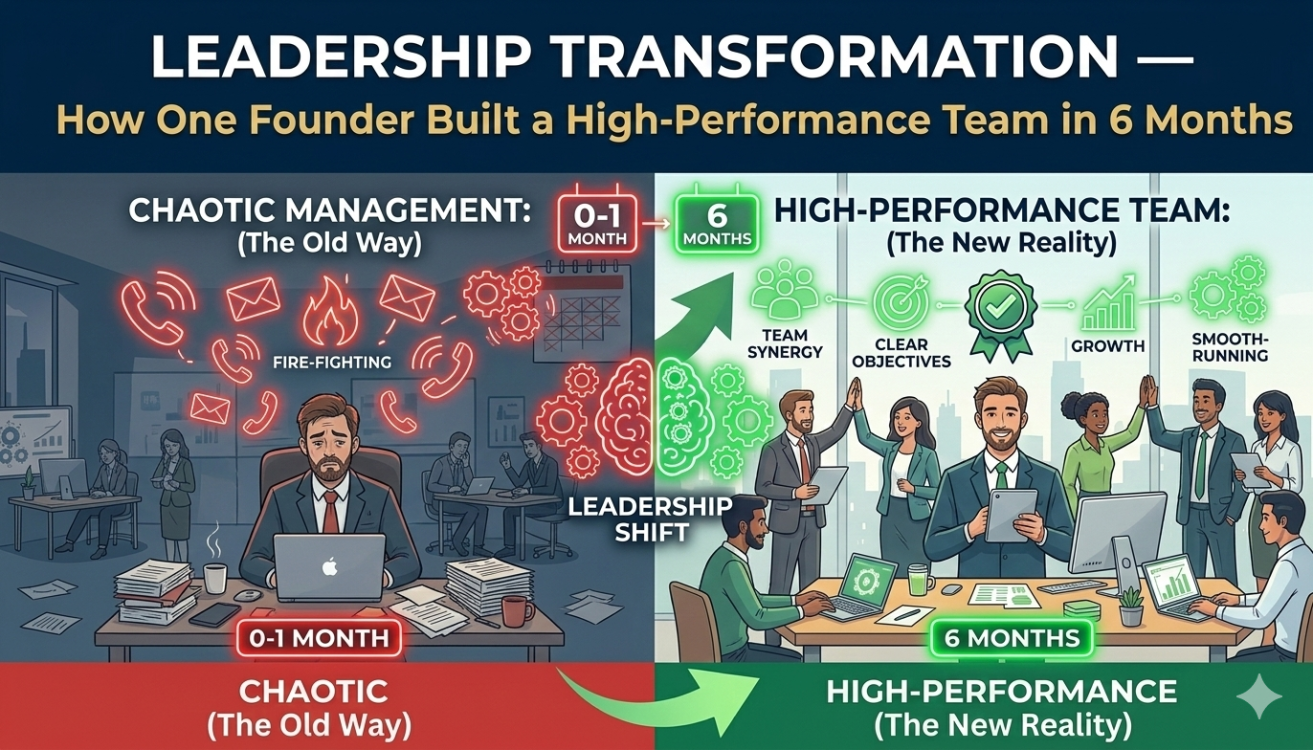
When Rajan Mehta came to us eighteen months ago, he was exhausted. His manufacturing unit in Pune — a 40-person operation supplying auto components to Tier-1 vendors — was generating decent revenue but hemorrhaging talent. Three senior people had quit in four months. Deadlines were slipping. And Rajan, who had built the business from scratch over nine years, was spending twelve hours a day firefighting problems that, frankly, shouldn’t have reached his desk.
“I’m the owner, the HR manager, the quality checker, and sometimes the delivery boy,” he told us in our first session. Half-laughing. Half-broken.
This is a story about what happened next.
The Real Problem Wasn’t the Team
Our first instinct as consultants is always to resist the obvious diagnosis. Rajan thought he had a “people problem.” After two weeks of structured interviews, process audits, and shadow sessions on the floor, we told him something he didn’t expect to hear:
He was the bottleneck.
Not because he lacked capability — quite the opposite. Rajan was extraordinarily competent, and his team knew it. So they had learned, over years, to wait for him. Every decision, every exception, every vendor call. The organization had quietly outsourced its thinking to its founder.
This is one of the most common patterns we see in MSMEs that have crossed the ₹5–15 crore revenue mark. The very qualities that built the business — the founder’s drive, instinct, and hands-on involvement — become the ceiling that prevents the business from scaling.
The team wasn’t underperforming. They were under-trusted.
The 6-Month Roadmap
We proposed a phased leadership transformation plan. No overnight overhaul. No expensive offsites. Just deliberate, structured shifts in how Rajan operated.
Months 1–2: Diagnosis and Role Clarity
We mapped every recurring decision in the business and asked one question: Does this actually require the founder? Roughly 60% of what landed on Rajan’s desk didn’t. We worked with him to define clear ownership for three team leads — production, quality, and client coordination — with explicit decision-making authority within defined boundaries.
This sounds simple. It rarely is. Letting go is a muscle founders have to build consciously.
Months 3–4: Structured Accountability, Not Surveillance
We introduced a lightweight operating rhythm: a 20-minute daily stand-up, a weekly team review, and a monthly performance conversation tied to three metrics per role. Nothing complicated. The goal was to create visibility without micromanagement — so Rajan could stay informed without staying involved in everything.
We also coached him on the difference between asking “Why didn’t you do this?” and “What did you need that you didn’t have?” One creates defensiveness. The other creates problem-solvers.
Months 5–6: Delegation with a Safety Net
The final phase was the hardest. We gave team leads ownership of a live client project each — end to end — with Rajan available as an advisor, not a decision-maker. There were stumbles. One delivery timeline slipped by a week. Rajan’s instinct was to step back in. We advised him not to.
Instead, the team lead owned the client call, explained the delay, proposed a solution, and retained the relationship. It was a turning point. Rajan told us later: “That’s when I realized they were more capable than I’d allowed them to be.”
What Changed in 6 Months
The results weren’t magic. They were compounded discipline.
- Zero senior attrition in the six months following the engagement
- Order fulfillment accuracy improved from 81% to 94%
- Rajan’s direct working hours dropped from 65 to 48 per week
- A previously stalled second production line was finally set up — because Rajan now had the bandwidth to focus on it
- Most importantly, the team leads began bringing solutions to meetings instead of problems
What We Learned (And What You Can Take Away)
Every MSME founder we work with is, in some sense, Rajan. The business is personal. The team feels like family. Trusting others with what you’ve built is genuinely difficult — not a character flaw, but a reasonable response to years of having been the person who cared most.
But here is the truth we return to again and again in our consulting work:
A business that can only run when the founder is present isn’t a business yet. It’s a job.
The transition from operator to leader isn’t about working less. It’s about working on the right things — vision, relationships, strategy, growth — while building a team that is genuinely trusted, genuinely capable, and genuinely accountable.
That transition is available to every founder willing to look honestly at themselves first.
The Perception Insights
By Vinod C. Pandita, Founder & CEO @ Perception Management Consulting Pvt. Ltd.