-
PX Consulting
- February 18, 2026
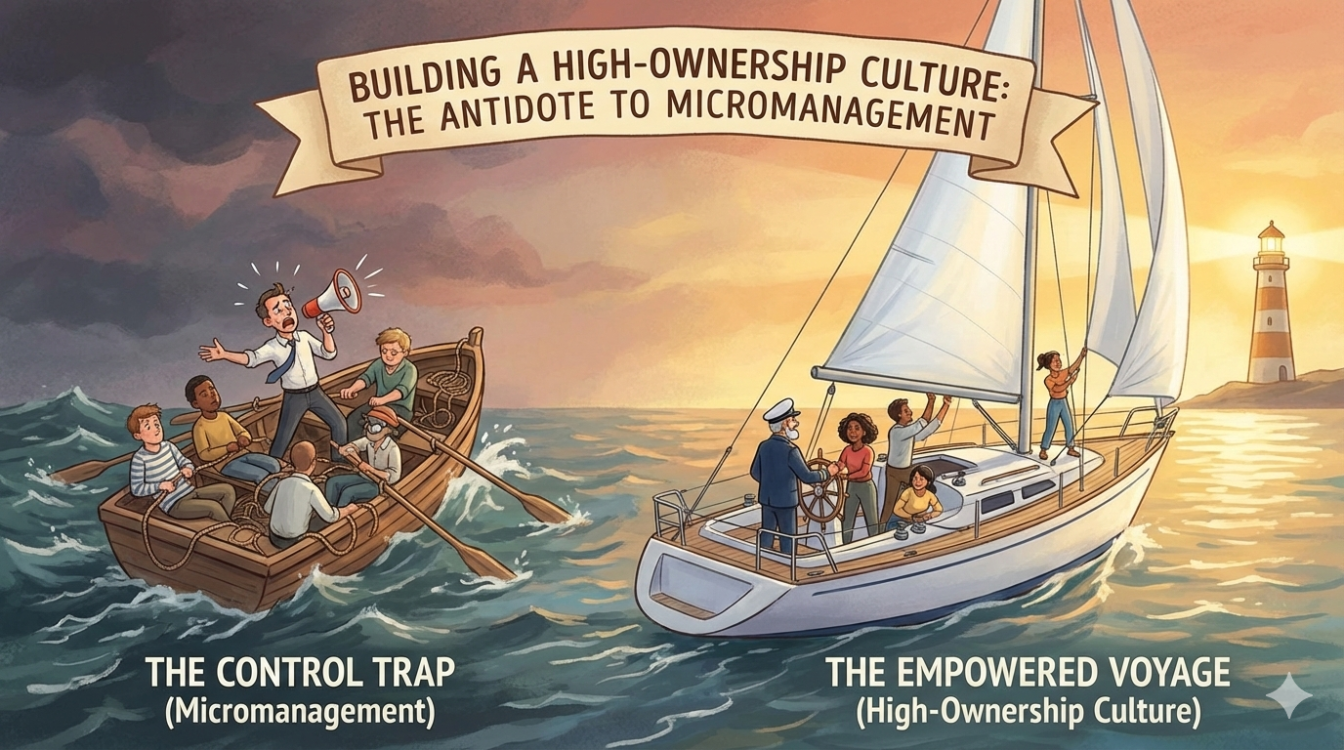
The Micromanagement Trap
You know the feeling. It’s 9 PM, and you’re still reviewing your team’s work, fixing errors, answering questions that should have been resolved hours ago. Your calendar is packed with approvals, check-ins, and “quick questions” that eat into your strategic thinking time.
You’re not leading. You’re micromanaging. And it’s killing your business growth.
The irony? You micromanage because you care. You want things done right. But here’s the uncomfortable truth: micromanagement doesn’t scale, doesn’t inspire, and doesn’t work.
What is a High-Ownership Culture?
A high-ownership culture is one where every team member thinks and acts like an owner—not just an employee. They don’t wait for permission. They don’t pass the buck. They see problems, own solutions, and drive results without constant supervision.
In a high-ownership culture:
- Team members make decisions within their scope without asking for permission
- Problems get solved at the lowest level possible
- People take pride in outcomes, not just output
- Accountability is internal, not imposed from above
- Your role as founder shifts from doer to coach
The Cost of Low Ownership
Before we talk about building ownership, let’s understand what you’re losing without it:
For the Business:
- Slow decision-making and execution
- Bottlenecks at every approval point (you)
- Inability to scale beyond founder’s capacity
- Missed opportunities due to permission delays
- High operational costs relative to output
For You as a Founder:
- Trapped in daily operations, no time for strategy
- Constant firefighting and reactive mode
- Decision fatigue from trivial choices
- Inability to take time off without chaos
- Burnout from carrying the entire business weight
For Your Team:
- Disengagement and learned helplessness
- “Not my job” mentality creeps in
- Best people leave for roles with more autonomy
- Innovation dies—why suggest if nothing changes?
- Dependency on founder for every decision
The 5 Pillars of High-Ownership Culture
1. Crystal Clear Expectations
Ownership without clarity is chaos. Your team can’t own what they don’t understand.
What to do:
- Define clear outcomes (not just tasks) for every role
- Set boundaries of authority: what can they decide vs. what needs approval?
- Document KRAs (Key Result Areas) and KPIs for each function
- Share the “why” behind decisions, not just the “what”
Example: Instead of “manage social media,” define “grow engaged followers by 20% quarterly through consistent content strategy you design and execute.”
2. Decision Rights Framework
Most micromanagement happens because decision authority is unclear. Build a simple framework:
Level 1 Decisions (Just Do It):
- Routine operational decisions within budget
- Standard processes and procedures
- Day-to-day customer interactions
Level 2 Decisions (Inform After):
- New approaches to existing problems
- Minor budget variances (define threshold)
- Process improvements
Level 3 Decisions (Discuss Before):
- Strategic pivots or new initiatives
- Major budget decisions
- Hiring/termination decisions
Level 4 Decisions (Founder Only):
- Company vision and mission
- Major partnerships or investments
- Legal or compliance issues
Make this framework visible and reference it often.
3. Trust + Verify System
High ownership doesn’t mean no accountability. It means smart accountability.
Instead of: Checking every email before it goes out
Do this: Weekly review of sent emails with coaching on 2-3 examples
Instead of: Approving every expense
Do this: Monthly budget review with variance analysis and learning
Instead of: Sitting in every client meeting
Do this: Weekly pipeline review + occasional shadowing for coaching
The rule: Trust by default, verify through systems, coach through gaps.
4. Consequences (Good and Bad)
Ownership without consequences is theater. People need to feel the impact of their decisions.
Positive Consequences:
- Public recognition when someone owns a problem and solves it
- Financial incentives tied to outcomes (not just tasks)
- Increased responsibility and authority for proven owners
- Career growth paths for those who demonstrate ownership
Negative Consequences:
- Direct feedback when ownership is lacking (not punishment, coaching)
- Reduced authority for those who consistently avoid ownership
- Natural consequences: if you don’t own the pipeline, you miss targets and feel it
- Clear performance improvement plans for persistent low-ownership behavior
The key: Be consistent. If you say ownership matters but reward people who always seek approval, you’re teaching the opposite.
5. Psychological Safety
This is the foundation. People won’t take ownership if they fear being punished for mistakes.
Create safety by:
- Celebrating “smart failures”—where someone took ownership, made a decision, and learned
- Never publicly shaming mistakes (coach privately, praise publicly)
- Modeling vulnerability—share your own mistakes and learnings
- Asking “what did we learn?” instead of “who screwed up?”
- Protecting your team from external blame when they were acting with best intent
Remember: Fear drives permission-seeking. Safety drives ownership.
The Ownership Mindset Shift
Building a high-ownership culture requires a fundamental mindset shift—for you and your team.
From Founder Thinking to Team Thinking
Stop saying:
- “Let me handle this”
- “I’ll fix it faster myself”
- “They can’t do it as well as I can”
- “I need to be in the loop on everything”
Start saying:
- “How would you approach this?”
- “What do you need from me to solve this?”
- “Make the call and let me know how it goes”
- “I trust your judgment on this”
From Blame to Growth
When something goes wrong (and it will), ask:
- What was the outcome we wanted?
- What decision did you make and why?
- What was the result?
- What would you do differently next time?
- What support do you need to succeed next time?
Notice what’s NOT in there: “Why did you mess up?” or “You should have asked me first.”
The 30-Day Ownership Challenge
You can’t build a high-ownership culture overnight, but you can start today. Here’s your 30-day plan:
Week 1: Define and Communicate
- Document decision rights framework for your team
- Share it in a team meeting and get buy-in
- Identify 3 decisions you’re currently making that should be Level 1 or 2
Week 2: Delegate and Let Go
- Hand off those 3 decisions with clear expectations
- Resist the urge to check in daily—trust the framework
- When someone asks for permission on a Level 1/2 decision, ask: “What do you think you should do?”
Week 3: Coach, Don’t Rescue
- When problems arise, coach through questions instead of jumping in
- Review outcomes (not every step) in a weekly 1:1
- Celebrate 1-2 examples of strong ownership publicly
Week 4: Refine and Scale
- Gather feedback: what’s working, what’s unclear?
- Adjust decision framework based on learnings
- Identify 3 more decisions to delegate next month
Track this metric: How many decisions come to you per week? Your goal is to reduce this by 50% in 90 days.
Common Pitfalls (And How to Avoid Them)
Pitfall #1: “But They’re Not Ready”
Reality check: They’ll never be ready if you don’t let them try. Start small, build confidence, increase complexity.
Pitfall #2: “It’s Faster If I Do It”
Reality check: Yes, today. But you’re training dependency. It’ll be slower forever if you don’t invest the time now.
Pitfall #3: “What If They Fail?”
Reality check: They will. That’s how learning happens. Make the stakes small enough that failure is a lesson, not a crisis.
Pitfall #4: “My Team Doesn’t Want More Responsibility”
Reality check: Most people do want it—they just don’t want to be blamed. Create safety first.
Pitfall #5: “I Tried Delegation—It Didn’t Work”
Reality check: Delegation without a framework isn’t ownership culture. You need all 5 pillars, not just one.
What High Ownership Looks Like in Practice
Example 1: Customer Complaint
Low Ownership: Customer complains → Team escalates to you → You solve it → Team waits for instructions
High Ownership: Customer complains → Team member owns it → Resolves within authority → Informs you of resolution → Documents learnings for team
Example 2: Budget Variance
Low Ownership: Expense over budget → Team seeks approval for every small variance → You’re in expense approval hell
High Ownership: Expense over budget → Team analyzes variance → Adjusts other items to stay within total budget → Informs you with explanation → Learns for next month
Example 3: Process Problem
Low Ownership: Process breaks → Work stops → Team waits for you to fix it
High Ownership: Process breaks → Team implements temporary workaround → Proposes permanent fix → You approve or refine → Team implements and documents
The Freedom on the Other Side
Here’s what life looks like when you build a high-ownership culture:
✅ Your calendar opens up – you’re in 50% fewer meetings
✅ Your team grows – people stay because they’re learning and owning
✅ Decisions happen faster – no more bottleneck at your desk
✅ You can take a vacation – without 47 “urgent” calls
✅ Innovation increases – people experiment without asking permission
✅ You focus on strategy – because operations run without you
✅ Your business scales – because it’s not dependent on your capacity
Most importantly: You stop feeling like you’re carrying the entire business on your shoulders.
Your Next Step
Building a high-ownership culture doesn’t happen by accident. It’s a deliberate choice, followed by consistent action.
Start today:
- Download our Decision Rights Framework Template
- Schedule a team meeting to introduce the ownership model
- Identify 3 decisions you’ll delegate this week
- Commit to coaching, not rescuing, for the next 30 days
Need help building this in your organization?
Our ABLE Team Building Mastery program helps MSME founders transform their teams from dependent to empowered in just 30 days. You’ll get:
- Proven frameworks for delegation and decision rights
- Weekly coaching with Vinod C Pandita
- Ready-to-use templates for role clarity and KRAs
- 24×7 support from a dedicated consultant
Investment: Rs. 55,000 + GST | Duration: 4 weeks
Book a Free Discovery Call | Learn More About Team Building Mastery
Final Thought
Micromanagement isn’t a personality flaw—it’s a systems problem. You micromanage because you haven’t built the structures that make ownership possible.
The good news? Systems can be built. Culture can be changed. Teams can be transformed.
The question is: Are you ready to let go?
Building the Muscle: Daily Practices for Ownership
Ownership culture isn’t built in a single team meeting—it’s built through consistent daily practices that reinforce the right behaviors.
Morning Huddles That Empower
Transform your daily stand-ups from status reports to ownership checkpoints:
Ask these three questions:
- “What are you owning today?” (not “what are you working on”)
- “What obstacles can you remove yourself vs. what do you need help with?”
- “What decision will you make today that moves us forward?”
The difference is subtle but powerful. You’re reinforcing that they own outcomes, they solve problems, and they make decisions.
The “Boomerang” Technique
When someone comes to you with a problem, resist the urge to solve it. Instead:
Step 1: “Tell me more about the situation.”
Step 2: “What solutions have you considered?”
Step 3: “Which one do you recommend and why?”
Step 4: “What do you need from me to execute that?”
Notice you never actually solved the problem—you coached them to solve it themselves. Do this consistently for 30 days, and watch the number of “can you help with this?” questions drop dramatically.
Weekly Ownership Reviews
Replace traditional performance reviews with ownership reviews:
Celebrate:
- Times they made decisions without asking
- Problems they solved proactively
- Initiatives they took that weren’t assigned
Coach on:
- Situations where they could have owned more
- Decision-making process (not just outcomes)
- Ways to expand their ownership zone
Plan:
- New areas they’re ready to own
- Support they need to be successful
- Metrics to track their ownership growth
This shifts the conversation from “did you complete your tasks?” to “how are you growing as an owner?”
Document and Share Wins
Create a simple system to capture ownership wins:
Weekly Slack/WhatsApp Channel: “#ownership-wins”
- Team member posts: “Owned the client escalation issue. Resolved in 2 hours without needing approval. Client happy, documented the process for future.”
- You react with recognition
- Team learns from each other’s ownership examples
Monthly Team Meeting: “Ownership Spotlight”
- Feature 2-3 significant ownership examples
- Have the team member share their thinking process
- Discuss what enabled them to take ownership
- Recognize publicly (and financially if possible)
This creates social proof that ownership is valued and rewarded.
Scaling Ownership as You Grow
The real test of ownership culture comes when you scale from 10 to 30 to 50+ people. Here’s how to maintain it:
Hire for Ownership
Add these questions to your interview process:
- “Tell me about a time you solved a problem without asking for permission.”
- “Describe a situation where you had to make a decision with incomplete information.”
- “What’s the biggest thing you’ve owned from start to finish in your last role?”
- “How do you respond when something fails that you were responsible for?”
Red flags:
- Always waited for direction
- Blamed others when things went wrong
- Needed constant validation
- Never took initiative beyond job description
Green flags:
- Took calculated risks
- Learned from failures
- Asked for forgiveness, not permission (appropriately)
- Sought responsibility, not just tasks
Onboard for Ownership
Your first 90 days set the tone. Here’s an ownership-focused onboarding:
Day 1-7: Learn the Framework
- Share decision rights framework
- Explain ownership culture and why it matters
- Set expectations: “We hired you to think, not just do”
Day 8-30: Guided Ownership
- Assign small decisions they can make immediately
- Daily check-ins: “What did you own today?”
- Encourage questions, but ask “What do you think?” first
Day 31-60: Increased Autonomy
- Expand decision authority
- Weekly (not daily) check-ins
- Focus on outcomes, not activities
Day 61-90: Full Ownership
- Should be making most decisions within their scope independently
- Monthly reviews focused on impact
- Ready to mentor next new hire on ownership
Middle Management: The Ownership Multipliers
Your managers make or break ownership culture. If they micromanage, your culture efforts die at the middle layer.
Train your managers to:
Replace “Did you do X?” with “What progress did you make on X?”
The first assumes they’re waiting for instructions. The second assumes they’re already moving.
Replace “You should do X” with “What’s your plan for X?”
The first tells. The second asks them to think and own the solution.
Replace “Let me review before you send” with “Send it and let me know what response you get”
The first creates dependency. The second creates confidence.
Coach your managers weekly: Review how many decisions their team brought to them vs. made independently. Goal is to reduce dependency over time.
Measuring Ownership Culture
You can’t improve what you don’t measure. Track these metrics quarterly:
Quantitative Metrics
Decision Velocity:
- Average time from problem identified to decision made
- Percentage of decisions made at Level 1-2 vs. escalated
- Number of decisions coming to founder per week
Autonomy Index:
- Percentage of team meetings you attend vs. skip
- Number of approval requests per person per week
- Percentage of projects completed without founder involvement
Outcome Quality:
- Error rates when decisions made without approval
- Customer satisfaction scores (ownership often improves this)
- Project delivery on-time percentage
Qualitative Metrics
Team Survey (Anonymous, Quarterly):
Rate 1-5:
- “I feel empowered to make decisions in my role”
- “I know what decisions I can make without asking”
- “Mistakes are treated as learning opportunities”
- “I’m encouraged to take initiative beyond my job description”
- “My manager trusts me to own outcomes”
Look for trends, not perfection. You want scores trending up over time.
The Transformation Timeline
Be realistic about timing. Culture change doesn’t happen overnight.
Months 1-3: Foundation & Resistance
- Introduce framework and expectations
- Expect pushback and testing
- Some team members uncomfortable with new responsibility
- You’ll be tempted to jump back in—resist
Months 4-6: Early Wins & Confidence
- First real ownership examples emerge
- Team starts making more decisions independently
- You feel slight reduction in daily interruptions
- Some team members thrive, some struggle
Months 7-12: Momentum & Culture Shift
- Ownership becomes “how we do things here”
- New hires absorb culture faster
- Significant reduction in decisions escalated to you
- Business outcomes improve noticeably
Year 2+: Self-Sustaining & Scaling
- Culture maintains itself through team modeling
- You focus almost entirely on strategy
- Business scales without adding to your workload
- High-ownership people attract other high-ownership people
The key: Commit to the full journey. Most founders quit at month 2 when it feels uncomfortable.
When Ownership Goes Wrong (And How to Fix It)
Let’s be honest—giving people ownership doesn’t always work perfectly. Here’s what can go wrong and how to address it:
Problem 1: Too Much Too Fast
Symptom: Team member makes costly mistake because they were in over their head.
Fix:
- Scale ownership gradually: small decisions → bigger decisions → strategic decisions
- Ensure they understand the “why” behind frameworks before expanding authority
- Set financial thresholds (e.g., “decisions under Rs. 10K you can make, above requires discussion”)
- Conduct “pre-mortems” on bigger decisions: “What could go wrong? How would you handle it?”
This isn’t a failure of ownership—it’s a failure of scaffolding.
Problem 2: Analysis Paralysis
Symptom: Team member has authority but constantly delays decisions, seeking more data/validation.
Fix:
- Set decision deadlines: “Make a call by Friday”
- Share your decision-making framework: how do YOU decide with incomplete info?
- Start with reversible decisions: “Try it for 2 weeks, then we’ll review”
- Reframe: “A good decision now is better than a perfect decision later”
Remember: Some people are wired to seek certainty. Coach them to be comfortable with 70% information.
Problem 3: Rogue Ownership
Symptom: Team member makes decisions well outside their authority/expertise, causing chaos.
Fix:
- Revisit decision rights framework—was it clear?
- Have direct conversation: “I love your initiative, AND we need boundaries”
- Install “big decision” checkpoints: “If it affects X, Y, or Z, let’s discuss first”
- Don’t punish the initiative—redirect it
This is actually a good problem. Better to reign in excess ownership than manufacture it from nothing.
Problem 4: Selective Ownership
Symptom: Team member owns the fun/easy stuff, dodges the hard/uncomfortable stuff.
Fix:
- Make ownership holistic: “You own customer success—that includes complaints”
- Link ownership to outcomes: “Pipeline growth includes both new leads AND nurturing cold ones”
- Address directly: “I notice you jump on X but avoid Y. Let’s talk about that”
- Sometimes this is a skill gap—provide training or support
Ownership means owning the whole problem, not just the pleasant parts.
Your Ownership Culture Starter Kit
Ready to begin? Here’s your practical starting point:
This Week:
Monday:
- Document 10 decisions you made last week
- Categorize: Which could have been made by your team?
- Identify 3 you’ll delegate starting tomorrow
Tuesday-Thursday:
- When team asks for decision, use Boomerang Technique
- Notice your discomfort when you don’t solve it
- Resist jumping in—let them figure it out
Friday:
- Conduct first Ownership Review with team
- Celebrate anyone who made a decision without asking
- Share the 3 decisions you’re officially delegating next week
Next 30 Days:
Week 2: Introduce Decision Rights Framework formally
Week 3: Start tracking “decisions escalated to me” metric
Week 4: Review and adjust—what’s working, what needs clarity
First 90 Days:
- Reduce decisions coming to you by 40%
- Have 3 significant ownership wins to celebrate
- Start feeling comfortable with “letting go”
- Team confidence visibly growing
Remember: Progress over perfection. Every decision you don’t make is a win.
The Ultimate Truth About Ownership
Here’s what nobody tells you: Building a high-ownership culture is as much about your transformation as your team’s.
You have to let go of:
- Being the hero who saves the day
- Being the smartest person in the room
- Being needed for every decision
- Being in control of every detail
And embrace:
- Being the coach who develops heroes
- Being the leader who asks great questions
- Being freed up for strategic thinking
- Being comfortable with imperfect execution
This is hard. Your identity as a founder is often tied to being indispensable. Ownership culture requires you to become dispensable in operations so you can be indispensable in strategy.
But here’s the beautiful irony: The moment you let go is the moment your business truly takes off.
Your team rises to the occasion. Innovation accelerates. Growth scales. And you finally get to work ON your business instead of IN it.
The Perception Insights
By Vinod C. Pandita, Founder & CEO @ Perception Management Consulting Pvt. Ltd.