-
PX Consulting
- January 5, 2026
Running a micro, small, or medium enterprise often feels like juggling too many balls at once. You’re managing operations, chasing payments, handling customer complaints, and somehow trying to grow the business—all while keeping costs under control. For many MSME owners, growth seems like a distant dream when daily survival takes all the energy.
But what if the breakthrough isn’t about working harder or finding that one big client? What if it’s about fixing what’s already broken inside your business?
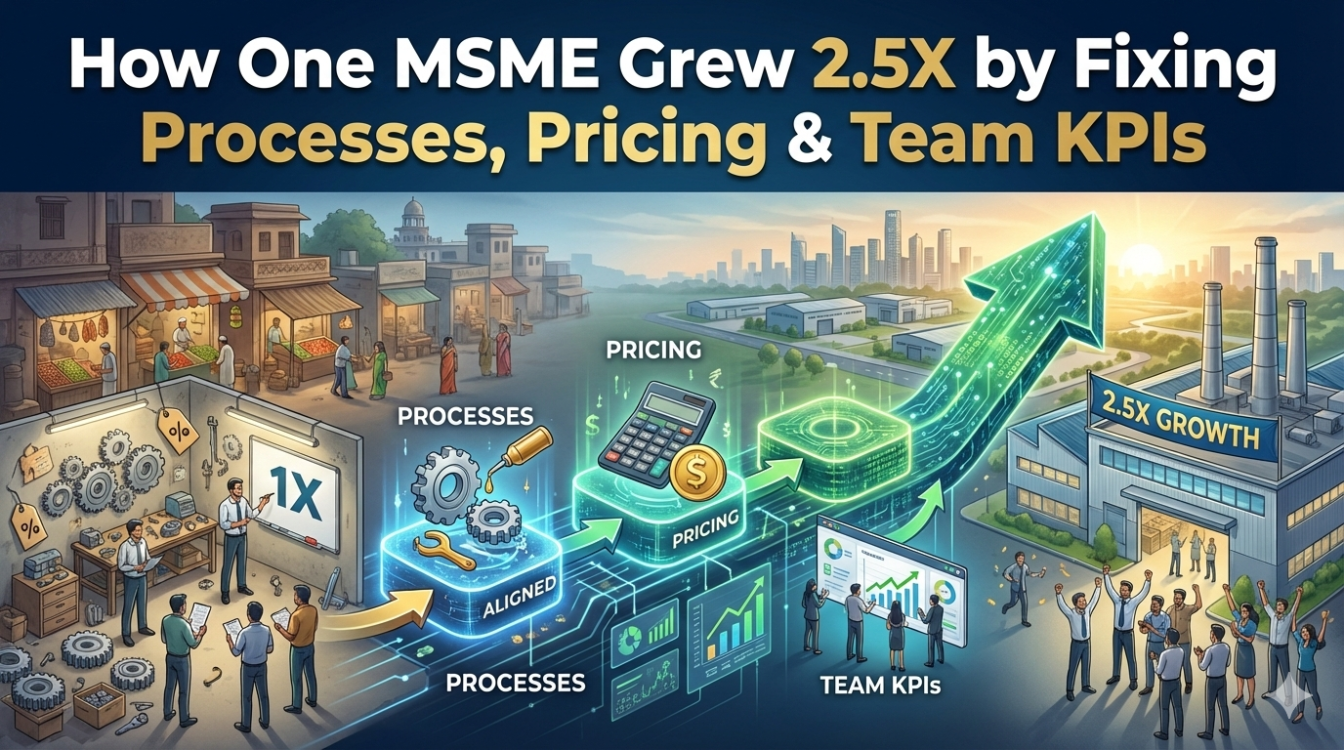
This is the story of how one MSME transformed itself from struggling to thriving by addressing three critical areas: processes, pricing, and team performance metrics. In just 18 months, they achieved 2.5X revenue growth—not through luck, but through systematic improvements that any business can replicate.
The Starting Point: Chaos Disguised as “Hustle”
The company, a manufacturing unit producing packaging materials for local businesses, had been operating for seven years. On paper, things looked decent—they had steady clients, a team of 25 people, and revenues hovering around ₹3.5 crore annually. But beneath the surface, cracks were widening.
The owner, Rajesh, described the situation candidly: “We were always busy, but never profitable. Every month felt like we were running just to stand still. Orders were delayed, clients complained, and my team seemed overworked yet underproductive.”
The warning signs were everywhere. Customer retention was poor, with nearly 40% of clients not returning for repeat orders. Profit margins had shrunk to barely 8%, well below the industry standard of 15-18%. Employee turnover was high, with key team members leaving every few months. Something had to change.
The Diagnosis: Three Critical Breakdowns
Before implementing any solutions, Rajesh brought in a business consultant to conduct a thorough audit. What emerged were three fundamental problems that many MSMEs face but rarely address systematically.
Problem 1: Broken Processes
The company had no standardized way of doing anything. Each order followed a different path depending on who handled it. Documentation was inconsistent, leading to frequent errors and rework. The production floor operated on verbal instructions rather than written procedures, which meant knowledge lived in people’s heads, not in systems.
Quality control was reactive rather than proactive. Defects were caught by customers, not during production. This led to costly returns, remakes, and damaged reputation. There was no clear workflow from order receipt to delivery, causing bottlenecks at unpredictable points.
Problem 2: Pricing Based on Guesswork
Like many small businesses, pricing was based on “what the market will bear” rather than actual costs. Rajesh admitted, “We’d look at what competitors charged and try to come in slightly lower. We never really calculated our true costs per order.”
This approach meant they were often working on thin margins or even losses without realizing it. Complex orders that required more time and materials were priced the same as simple ones. There was no mechanism to account for waste, rework, or overhead costs properly. Discounts were given arbitrarily to close deals, further eroding profitability.
Problem 3: No Meaningful Team KPIs
The team worked hard, but there was no way to measure what “good” looked like. Sales targets existed, but they weren’t tied to profitability or customer satisfaction. Production staff had no clear quality or efficiency metrics. Employee performance reviews happened once a year and were mostly subjective.
This lack of measurement meant there was no accountability, no way to identify top performers to reward or struggling employees to support. The team operated in the dark, unsure whether their efforts were moving the business forward.
The Transformation: Three Pillars of Change
Armed with this diagnosis, Rajesh committed to a systematic turnaround. The journey wasn’t easy, but the approach was clear: fix the fundamentals before chasing growth.
Pillar 1: Process Standardization and Documentation
The first step was to map every single process in the business, from lead generation to final delivery and payment collection. The team documented each step, identified who was responsible, and determined the expected timeline and output.
They created standard operating procedures for production, quality control, inventory management, and customer service. These weren’t elaborate documents—simple, one-page workflows that anyone could follow. Visual aids were placed on the production floor so workers could reference correct procedures without asking supervisors.
A quality checklist was introduced at three stages: raw material inspection, mid-production check, and final product verification. This simple addition reduced defect rates by 60% within three months. Digital tools were adopted for order tracking, allowing both the team and customers to see real-time progress.
The impact was immediate. Order fulfillment time dropped from an average of 12 days to 7 days. Rework costs fell by half. New employees could be onboarded faster because processes were documented rather than learned through trial and error.
Pillar 2: Cost-Based Pricing Strategy
Next came the uncomfortable but necessary task of understanding true costs. The finance team conducted a detailed cost analysis, breaking down every expense: raw materials, labor, utilities, rent, machinery depreciation, and administrative overhead.
They calculated the cost per unit for different product categories and different order sizes. This revealed some startling truths—certain products they thought were profitable were actually losing money, while others they’d been underpricing had much higher margins than realized.
Armed with this data, they restructured their pricing. Standard products got a clear price list based on cost plus desired margin. Custom orders were priced using a formula that accounted for complexity, special materials, and setup time. A minimum order value was established to avoid unprofitable small orders.
Perhaps most importantly, they stopped competing purely on price. Instead, they emphasized their improved reliability, quality, and on-time delivery. They lost a few price-sensitive customers but attracted better clients who valued consistency.
Within six months, gross margins improved from 8% to 16%. Revenue per order increased by 23% even as order volume remained stable. The business was finally making money, not just generating sales.
Pillar 3: Team KPIs and Performance Management
The final piece was creating accountability through measurement. Different roles got different metrics, but everyone had clear, achievable targets tied to business outcomes.
Sales team KPIs included not just revenue but also customer retention rate, average order value, and payment collection timeline. Production metrics covered output per shift, defect rate, material wastage, and on-time completion percentage. Customer service was measured by response time, complaint resolution rate, and customer satisfaction scores.
These metrics were reviewed weekly in short team meetings. Top performers were recognized publicly and rewarded with bonuses. Underperformers received coaching and support to improve. The key shift was from blaming individuals for problems to helping them understand how their work connected to company success.
An incentive structure was introduced linking a portion of compensation to achieving KPIs. This wasn’t punitive—it was designed to share the gains of improved performance with the team. When margins improved, everyone benefited.
The cultural shift was profound. Employees started taking ownership of their areas. Suggestions for improvement came from the floor, not just management. Turnover dropped dramatically as people felt their work mattered and was recognized.
The Results: 2.5X Growth and Beyond
Eighteen months after starting this transformation, the results spoke for themselves. Annual revenue grew from ₹3.5 crore to ₹8.7 crore—a 2.5X increase. But the financial numbers only told part of the story.
Profit margins had doubled, meaning the business wasn’t just larger but significantly more profitable. Customer retention jumped to 78%, with many clients increasing their order frequency. Employee satisfaction improved measurably, with voluntary turnover dropping to near zero. The owner finally had time to work on the business rather than in it, focusing on strategy and new opportunities.
Perhaps most importantly, the business became scalable. With documented processes and clear metrics, growth no longer depended on Rajesh being involved in every decision. The foundation was laid for sustainable expansion.
Lessons for Other MSMEs
This transformation story isn’t unique to one company—it’s a blueprint that any MSME can follow. The lessons are universally applicable whether you’re in manufacturing, services, retail, or any other sector.
Start with processes, not growth. Before chasing more customers, ensure you can deliver consistent quality to existing ones. Document everything so knowledge isn’t trapped in individuals’ heads. Make your business teachable and repeatable. This creates the foundation for scaling.
Know your true costs before setting prices. Many small businesses fail not because they lack customers but because they’re selling at a loss without realizing it. Price based on value and costs, not just competition. Don’t be afraid to let go of unprofitable customers—they’re actually costing you money.
Measure what matters and make it visible. You can’t improve what you don’t measure. Choose metrics that directly impact business outcomes. Share these numbers with your team and make them partners in hitting targets. Celebrate progress and learn from shortfalls together.
Leadership matters more than you think. The owner’s commitment to change made this transformation possible. If leadership isn’t willing to examine hard truths and make tough decisions, no strategy will work. Be willing to invest time and resources in getting the fundamentals right before expecting dramatic results.
Getting Started: Your First 90 Days
If this story resonates and you’re wondering where to begin, here’s a practical 90-day roadmap for initiating your own transformation.
Days 1-30: Audit and Understand
Conduct a brutal honest assessment of your current state. Map your key processes from end to end. Calculate your true costs for main products or services. Survey your customers about satisfaction and pain points. Talk to your team about obstacles they face daily.
Days 31-60: Document and Standardize
Create written procedures for your top three most critical processes. Implement a basic quality control system. Develop a simple cost-tracking method for different products or services. Set up a dashboard to track the five metrics that matter most to your business.
Days 61-90: Implement and Measure
Train your team on new processes and get their feedback. Adjust pricing based on actual costs and desired margins. Roll out initial KPIs and review them weekly with team members. Celebrate quick wins and learn from what isn’t working yet.
This isn’t a quick fix—it’s a commitment to building a better business one process at a time. But as this MSME discovered, the results are worth every bit of effort. The difference between struggling and thriving often isn’t about the market, the competition, or even the product. It’s about how well you execute the fundamentals.
The Road Ahead
Today, Rajesh’s company is exploring opportunities that seemed impossible 18 months ago—expanding into new markets, adding product lines, even considering acquiring a smaller competitor. But he’s clear about what enabled this position: “We didn’t grow by chasing every opportunity. We grew by becoming excellent at what we already did. Once we fixed our foundation, growth became the natural outcome.”
For MSMEs everywhere facing similar challenges, the message is clear. You don’t need massive capital, revolutionary technology, or perfect market conditions to transform your business. You need the courage to look honestly at what’s broken and the discipline to fix it systematically.
The tools are simple: documented processes, cost-based pricing, and meaningful metrics. The results can be extraordinary. Your 2.5X growth story might be just one decision away—the decision to stop accepting chaos as normal and start building the business you actually want to run.
The Perception Insights Newsletter
By Vinod C. Pandita, Founder & CEO @ Perception Management Consulting Pvt. Ltd.