-
PX Consulting
- February 25, 2026
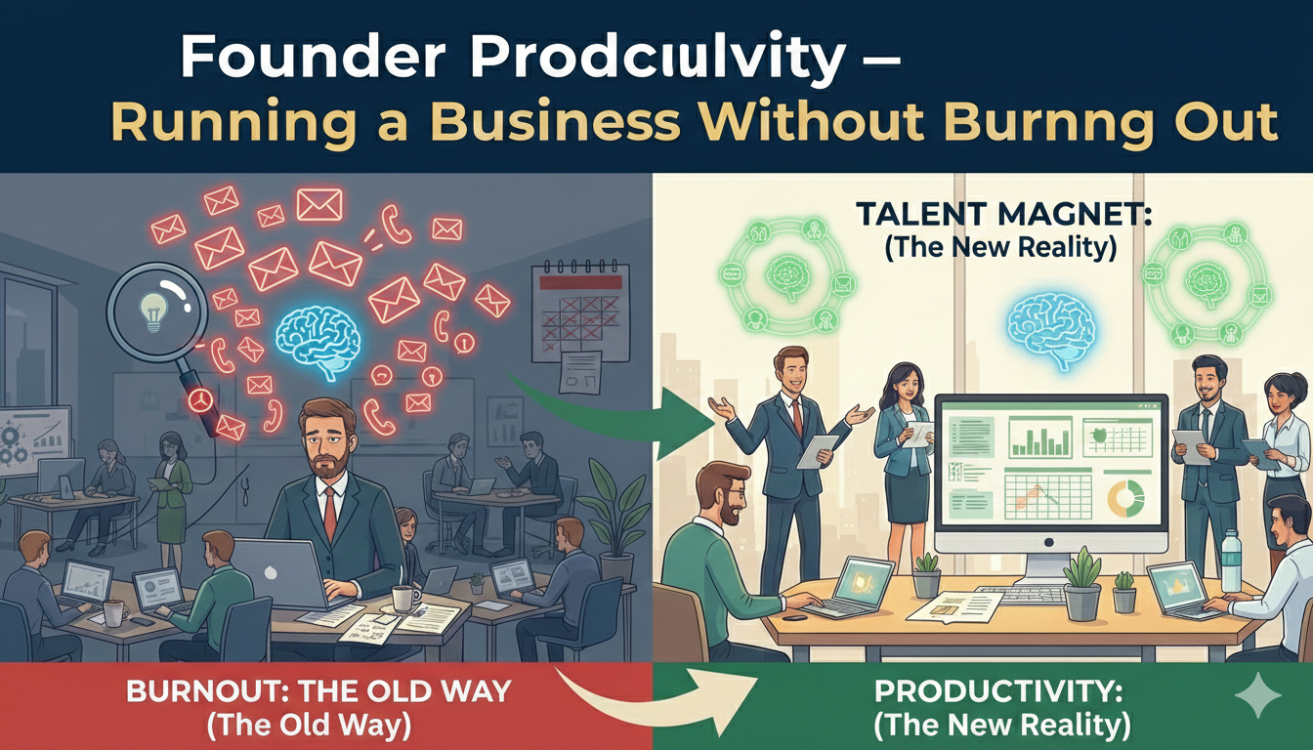
Vikram collapsed at his desk at 11 PM on a Tuesday. His wife found him an hour later, still slumped over his laptop, exhausted beyond measure.
He hadn’t taken a day off in eight months. He was answering customer emails at 6 AM and reviewing finances at midnight. His health was deteriorating. His marriage was strained. His 12-year-old daughter barely saw him.
Yet his business wasn’t growing proportionally to his effort. Revenue had plateaued at 4.5 crore for two years. He was working 80-hour weeks to stand still.
This is the dirty secret of entrepreneurship that nobody talks about. The glorification of hustle culture. The badge of honor in working yourself to exhaustion. The myth that success requires sacrificing everything else in your life.
It’s not just wrong. It’s dangerous. And it’s completely unnecessary.
The Burnout Epidemic Among Indian Founders
Walk into any MSME owner’s office and you’ll see the signs. Dark circles under eyes that haven’t seen proper sleep in months. Phones buzzing constantly with WhatsApp messages from customers, suppliers, and employees. Lunch eaten hurriedly at the desk while reviewing quotations. Evening plans cancelled because a crisis emerged.
The statistics are sobering. Over 60% of small business owners report high stress levels affecting their health. Nearly 40% say their business negatively impacts their personal relationships. The average MSME founder works 60-70 hours per week, yet feels constantly behind.
The worst part? Most founders believe this is just how it has to be. They see successful entrepreneurs on social media posting at all hours and assume that’s the price of success. They watch competitors work weekends and fear falling behind if they don’t do the same.
But here’s what they’re missing. The most successful founders aren’t the ones working the most hours. They’re the ones working the smartest hours.
Why Founder Burnout Happens
Before we solve the problem, we need to understand its roots. Burnout doesn’t happen because founders are lazy or weak. It happens because of specific structural problems in how MSMEs operate.
No Distinction Between Urgent and Important
Everything feels urgent when you’re running a small business. A customer complaint. A supplier delay. An employee question. A payment follow-up. Your day becomes an endless stream of putting out fires.
What gets sacrificed? The important but not urgent work. Strategic planning. Business development. Process improvement. Team development. The very activities that would actually grow your business and reduce your workload over time.
You spend 90% of your time on activities that could be delegated and 10% on activities only you can do. This should be reversed.
Inability to Delegate Effectively
Most founders struggle to let go. They believe nobody can do the work as well as they can. They’ve been burned by employees who made mistakes. They worry that delegating means losing control.
So they hold onto everything. Customer relationships. Vendor negotiations. Quality control. Financial decisions. Even tasks that could easily be handled by others. This creates an impossible bottleneck where you are the limiting factor in every aspect of your business.
Lack of Systems and Documentation
When processes exist only in your head, only you can execute them. Every decision requires your involvement because there are no guidelines for others to follow. Every problem escalates to you because there are no documented procedures for resolution.
This dependency is exhausting and unsustainable. It also makes your business fragile. If something happens to you, everything falls apart.
Fear-Based Decision Making
Many founders operate from a place of constant anxiety. Fear of losing customers. Fear of cash flow problems. Fear of competition. Fear of employee mistakes. This fear drives reactive behavior where you’re constantly responding to perceived threats rather than proactively building.
Fear-based operating is mentally and emotionally exhausting. You can never relax because threats feel omnipresent.
No Boundaries Between Work and Life
When you own the business, work never truly ends. Customers message you on Sunday evenings. Suppliers call during family dinners. Your mind races with business problems while trying to sleep. There’s no clear line between work time and personal time.
This constant state of semi-work means you’re never fully present anywhere. You’re not fully engaged with your family because you’re thinking about business. You’re not fully focused on business because you’re guilty about neglecting family.
The Productivity Mindset Shift
Solving founder burnout starts with changing how you think about productivity and success. Traditional productivity advice doesn’t work for business owners because your work is fundamentally different from employees.
Energy Management Over Time Management
Stop thinking about managing your time. You can’t create more hours in the day. Start thinking about managing your energy. You have limited mental, physical, and emotional energy each day. How you allocate that energy determines your effectiveness.
Your peak cognitive hours, usually the first 3-4 hours after you’re properly awake, should be protected fiercely for your most important work. Strategic thinking. Problem solving. Creative work. Not email. Not meetings. Not administrative tasks.
Schedule deep work blocks where you’re completely unavailable. Turn off phone. Close email. Lock the door if necessary. This uninterrupted time is where real progress happens.
Leverage Over Effort
Working harder isn’t the answer. Working with leverage is. Every hour you invest should be evaluated by the question: does this create ongoing value or is this a one-time effort?
Building a system that generates leads automatically has leverage. Responding to individual customer inquiries manually doesn’t. Training someone to handle a task you currently do has leverage. Continuing to do it yourself doesn’t. Creating documented processes has leverage. Keeping knowledge in your head doesn’t.
Focus relentlessly on high-leverage activities. Everything else should be delegated, automated, or eliminated.
Subtraction as Strategy
Most founders keep adding to their plate. New products. New services. New markets. New initiatives. Their to-do list grows endlessly. This is a recipe for burnout.
The most productive founders are masters of subtraction. They ruthlessly eliminate activities that don’t directly contribute to their core objectives. They say no to opportunities that don’t align with strategy. They prune products, customers, and initiatives that consume disproportionate energy relative to returns.
What can you stop doing? What would happen if you eliminated your three least profitable products? What if you stopped attending certain meetings? What if you fired your most demanding, least profitable customer?
Often, subtraction creates more growth than addition because it frees energy for what truly matters.
The Practical Framework for Sustainable Productivity
Understanding concepts is useful. Implementing systems is what creates change. Here’s a practical framework for running your business without burning out.
The Four Buckets System
Categorize every activity in your business into four buckets. Only You activities that only you can do because they require your unique relationships, judgment, or authority. Strategic decisions. Key customer relationships. Major partnerships. These might be 10-15% of current activities but should be 40-50% of your time.
Delegate Now activities that others can do if properly trained. Customer service. Routine operations. Administrative tasks. These should move off your plate within 60-90 days.
Automate activities that can be handled by systems or technology. Inquiry responses. Appointment scheduling. Data entry. Reporting. Invoice generation. These should be automated within 90 days.
Eliminate activities that don’t meaningfully contribute to business outcomes. Excessive reporting. Unnecessary meetings. Low-value customer segments. Eliminate these immediately.
Spend one week tracking every activity you do in 30-minute blocks. Then categorize each activity. You’ll be shocked how much time you spend on Delegate, Automate, and Eliminate activities.
The Sacred Morning Routine
Your morning sets the tone for your entire day. Most founders wake up and immediately check their phones, diving into reactive mode before they’ve even had coffee. This pattern guarantees you’ll spend the day responding rather than creating.
Create a morning routine that prepares you mentally and physically. This might include exercise, meditation, journaling, reading, or planning. No phone, no email, no business communication until your routine is complete.
During your morning routine, identify your three most important tasks for the day. Not your longest to-do list. Your three highest-impact activities. If you accomplish only these three things, the day is successful regardless of what else happens.
Protect your first 2-3 hours of work time for these high-impact activities. This is your peak cognitive time. Use it for your most important work, not for checking email or attending meetings.
The Delegation System
Effective delegation isn’t just handing off tasks randomly. It’s a systematic process that builds capability in your team while freeing your time.
Start by documenting how you currently perform tasks you want to delegate. Create simple standard operating procedures. These don’t need to be elaborate. Screen recordings, checklists, or step-by-step notes work fine.
Identify the right person to receive the delegation. Consider capability, capacity, and development opportunity. Sometimes the obvious person isn’t available. You might need to hire or reassign responsibilities.
Train thoroughly. Walk through the procedure together. Have them perform it while you observe. Provide feedback. Have them teach it back to you to confirm understanding. Good delegation training takes time upfront but saves enormous time long-term.
Grant appropriate authority. If you’re delegating customer complaint resolution, give them authority to issue refunds up to a certain amount. If you’re delegating vendor management, give them authority to approve orders within parameters. Delegating responsibility without authority doesn’t work.
Establish checkpoints without micromanaging. Weekly reviews of delegated activities. Monthly assessment of outcomes. You’re staying informed without being involved in daily execution.
The Protected Time Blocks
Your calendar should have protected time blocks for different types of work. Deep work blocks of 2-3 hours for strategic thinking, planning, or creative work. No interruptions allowed. Schedule these during your peak energy hours.
Administrative blocks of 60-90 minutes for emails, paperwork, and routine tasks. Batch these activities rather than doing them throughout the day. Check email twice daily during admin blocks, not constantly.
Meeting blocks where all meetings get scheduled. This prevents meetings from fragmenting your entire day. You might have meeting blocks Tuesday and Thursday afternoons. Everything else is meeting-free for focus work.
Personal time blocks that are non-negotiable. Exercise. Family dinner. Date night. Kid’s events. These go on your calendar first, and work schedules around them. If personal time is whatever’s left after work, there will never be enough.
The Weekly Review System
Every week, schedule 60-90 minutes for a structured review. This is perhaps the single most important productivity practice.
Review what you accomplished versus what you intended. Where did you succeed? Where did you fall short? Why? Review how you spent your time. Did you focus on high-leverage activities or get pulled into reactive work? Review your energy levels. When were you most energized? Most drained? What patterns emerge?
Plan the upcoming week strategically. What are your three most important outcomes? What activities will create those outcomes? What meetings or commitments do you have? What can be moved, delegated, or eliminated?
This weekly review creates intentionality. Without it, weeks blend together in a blur of reactive busyness without meaningful progress.
The Health and Boundaries Imperative
Productivity isn’t just about work systems. It’s about sustaining the physical and mental health that makes effective work possible. No amount of productivity hacks can compensate for poor health or burnout.
Non-Negotiable Health Practices
Sleep is not optional. Most adults need 7-8 hours. When you’re consistently getting less, cognitive performance declines dramatically. You make worse decisions. You’re more irritable. You’re less creative. The hours you “save” by sleeping less cost you far more in reduced effectiveness.
Regular exercise isn’t a luxury. It’s essential for mental clarity, stress management, and sustained energy. This doesn’t mean training for marathons. It means 30-45 minutes of movement most days. Walking. Yoga. Gym. Whatever you’ll actually do consistently.
Proper nutrition throughout the day maintains stable energy and mental performance. Skipping meals or eating poorly might seem like saving time. It’s actually costing you effectiveness. Plan and prepare healthy meals or arrange reliable sources.
Hard Boundaries
Decide your work hours and communicate them clearly. Perhaps you work 8 AM to 7 PM Monday through Friday and Saturday mornings. Outside these hours, you’re unavailable except for genuine emergencies. Real emergencies, not every customer issue.
Create separate phone numbers or WhatsApp business accounts. Your personal number is for family and friends. Your business number is for work. This allows you to truly disconnect during personal time.
Take one full day off weekly with zero work. No email checking. No phone calls. No thinking about business problems. A complete mental break that allows recovery and perspective.
Schedule real vacations, minimum one week twice yearly. Actual vacation where you’re away from the business. If your business can’t survive without you for a week, you have an urgent business problem to fix, not a reason to skip vacation.
The Reality Check
Vikram, the founder we met at the beginning, implemented these systems over six months. He started by tracking his time and was horrified to discover he spent less than 10% on high-value strategic work. He documented his three most time-consuming tasks and trained team members to handle them.
He established sacred morning time from 6 AM to 9 AM for strategic work before anyone could reach him. He implemented weekly reviews where he planned intentionally rather than reacting constantly. He set hard boundaries on evenings and Sundays.
The business didn’t collapse as he feared. Revenue actually grew 35% because he finally had time for business development and strategic initiatives. His team became more capable and confident. His health improved. His marriage recovered.
Most importantly, he stopped wearing exhaustion as a badge of honor and started measuring success by results and quality of life, not hours worked.
The Path Forward
Running a business without burning out isn’t about working less. It’s about working differently. It’s about leverage, systems, delegation, and boundaries. It’s about recognizing that you are your business’s most valuable asset, and protecting that asset requires taking care of yourself.
Start small. Choose one practice from this article to implement this week. Perhaps it’s tracking your time to understand where it actually goes. Perhaps it’s establishing a morning routine. Perhaps it’s documenting one task you can delegate.
Next week, add another practice. Then another. Small changes compound into transformation. Six months from now, you can be running your business with more effectiveness and less exhaustion than you currently think possible.
The alternative is continuing on your current path until something breaks. Your health. Your relationships. Your business. Or all three.
You started your business to create a better life, not to sacrifice everything for it. That better life is possible. But it requires intentional design, not default hustle.
The question isn’t whether you can afford to change how you work. The question is whether you can afford not to.
The Perception Insights
By Vinod C. Pandita, Founder & CEO @ Perception Management Consulting Pvt. Ltd.