-
PX Consulting
- January 19, 2026
Every MSME owner has been there. A potential customer calls. You drop everything. You promise the moon. You negotiate on the spot. You close the deal by offering a discount you can’t afford. Then you scramble to deliver.
It feels like hustle. It looks like success. But it’s actually chaos dressed up as entrepreneurship.
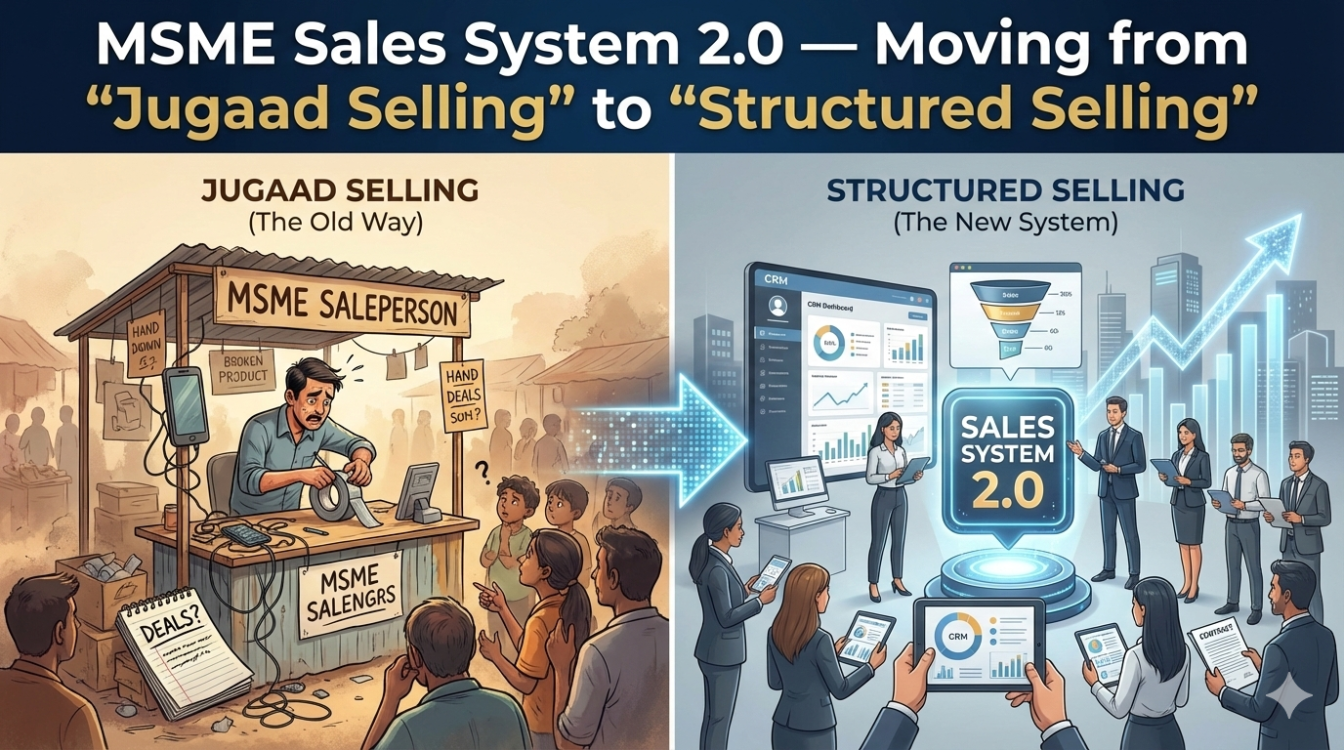
This is “jugaad selling” and it’s quietly killing thousands of MSMEs across India. Not through dramatic failures, but through slow exhaustion, inconsistent results, and businesses that can never scale beyond the owner’s personal network and daily hustle.
Let me introduce you to Amit, who runs a precision components manufacturing unit in Pune. After twelve years in business, he was generating 5 crore in annual revenue. His days looked like this: Wake up at 6 AM to take customer calls. Rush to the factory by 8 AM. Handle production issues until 11 AM. Take sales meetings from noon to 4 PM. Follow up on payments until 7 PM. Answer customer queries until 9 PM. Repeat.
Amit was the business. Every sale depended on his relationships, his judgment calls, his negotiations. When he took a week off for his daughter’s wedding, sales dropped 60%. His team didn’t know how to handle inquiries without him. Customers insisted on speaking to “Amit sir” directly.
He had a business that employed 35 people, but he was essentially running a one-man show with expensive support staff.
Sound familiar?
The problem wasn’t effort. Amit worked harder than almost anyone I’ve met. The problem was the absence of a sales system. Everything ran on jugaad, personal relationships, and daily firefighting.
Then something changed. Amit spent six months building what he now calls his “Sales System 2.0.” Today, his business generates 9.2 crore with him spending half the time on sales activities. His team closes deals without his involvement. New salespeople become productive within weeks instead of months. Customer acquisition costs have dropped by 40%.
Here’s how he made that transformation, and more importantly, how you can too.
Understanding Jugaad Selling: Why It Stops Working
Before we talk about solutions, let’s be honest about the problem. Jugaad selling has some genuine strengths, which is why it’s so prevalent. It’s flexible, responsive, and works reasonably well when you’re small.
But it has fatal flaws that emerge as you try to grow.
The Jugaad Selling Characteristics
Every deal is negotiated from scratch. Pricing depends on your mood, the customer’s persistence, and whether you’ve hit this month’s target. Two identical customers might pay wildly different amounts for the same product.
Your sales process lives entirely in your head. You know who to call, when to follow up, how to handle objections. But this knowledge isn’t documented or transferable. When you hire a salesperson, they start from zero because there’s no playbook to follow.
Customer relationships are personal, not institutional. Customers buy from you, not from your company. This feels good, but it makes you irreplaceable and the business unsellable. It also means when a key relationship manager leaves, customers often follow.
Sales forecasting is guesswork. You have no idea what next quarter looks like because there’s no pipeline visibility. You don’t know which leads are qualified or which deals are actually likely to close. Every month is a surprise, good or bad.
Your conversion rates are unknown. You couldn’t tell me what percentage of inquiries become quotes, quotes become proposals, or proposals become closed deals. Without these metrics, you can’t identify where leads are leaking or what to improve.
This approach works fine when you’re doing 50 lakhs or even 1 crore in revenue. The owner can personally handle all sales activities. But the moment you try to scale beyond what one person can manage, everything breaks down.
The Cost of Jugaad Selling
Let’s talk about what this actually costs you, because the damage is often invisible until you calculate it.
Revenue Inconsistency
Without a structured pipeline, your revenue resembles a roller coaster. Great months followed by terrible months. You can’t predict cash flow. You can’t plan hiring or inventory or investments because you don’t know what’s coming.
This inconsistency also affects your team’s morale. When sales are down, everyone panics. When sales are up, everyone relaxes instead of building on momentum. There’s no steady rhythm of execution.
Profit Margin Erosion
Inconsistent pricing means you’re often leaving money on the table or giving away margin unnecessarily. Amit discovered he was charging some customers 40% less than others for identical products, simply because those negotiations happened when he was desperate for orders.
Without a clear pricing framework, every deal becomes a margin negotiation. Customers quickly learn to push for discounts, knowing you’ll cave if they’re persistent enough.
Inability to Scale
This is the killer. As long as sales depends on you personally, you’ve built a job, not a business. You can’t take vacation. You can’t work on strategy. You can’t scale beyond what you can personally handle.
Hiring more salespeople doesn’t help because they don’t know what you know. They struggle, get demotivated, and leave. You’re back to doing it all yourself.
Customer Experience Suffers
Ironically, the personal touch that feels like an advantage actually creates inconsistent customer experiences. Some customers get immediate responses. Others wait days. Some get excellent service. Others fall through cracks.
Without systems, customer service quality depends entirely on who handles the inquiry and what kind of day they’re having.
What is Structured Selling?
Structured selling doesn’t mean removing the human element or becoming robotic. It means creating repeatable, documented systems that deliver consistent results while freeing you from daily tactical execution.
Think of it like this: Jugaad selling is like cooking without recipes. Every dish depends on the chef’s mood and memory. Structured selling is like having tested recipes that anyone trained can follow to produce consistent quality.
The Core Components
A structured sales system has five essential elements that work together:
Defined Sales Process
Your sales process is documented step-by-step from first contact to closed deal. Everyone follows the same process. Every lead moves through the same stages. This creates consistency and allows you to measure what’s working and what isn’t.
For Amit, this meant defining six stages: Inquiry, Qualification, Technical Discussion, Quotation, Negotiation, Closure. Each stage had clear entry and exit criteria. A lead couldn’t move to quotation until specific qualification questions were answered.
Clear Qualification Criteria
Not every inquiry deserves the same effort. You need objective criteria to identify which leads are worth pursuing aggressively and which aren’t a good fit.
Amit created a simple scoring system based on order size, technical requirements match, payment terms, and timeline. Leads scoring above 7 out of 10 got priority attention. Those below 4 were politely redirected. This alone saved hundreds of hours wasted on unqualified prospects.
Standardized Pricing Framework
This doesn’t mean fixed pricing for everything, but clear rules for how pricing gets determined. What’s the base price? What variables affect pricing? What’s the approval process for discounts? What’s the minimum acceptable margin?
With clear pricing guidelines, your sales team can quote confidently without checking with you constantly. Customers get consistent pricing. Margins improve because discounting becomes the exception, not the norm.
Sales Playbook and Scripts
Document the common scenarios, objections, and conversations that happen repeatedly. What questions should salespeople ask during qualification? How should they handle the “your competitor is cheaper” objection? What information do they need to gather for technical products?
This isn’t about reading from a script robotically. It’s about giving new team members the wisdom that took you years to accumulate, so they can be effective in weeks instead of years.
Performance Metrics and Dashboards
What gets measured gets managed. You need visibility into key metrics: number of inquiries, conversion rates at each stage, average deal size, sales cycle length, win/loss reasons, revenue by customer segment.
These metrics allow you to identify problems early and make data-driven improvements. They also create accountability. Your sales team knows what’s expected and how they’re performing.
Building Your Sales System 2.0: The Implementation Roadmap
Creating a structured sales system feels overwhelming when you’re in the middle of jugaad chaos. The trick is approaching it systematically in phases.
Phase One: Document Your Current Reality
Before you can improve the process, you need to understand what the current process actually is. Spend two weeks documenting every sales interaction.
What happens when an inquiry comes in? Who handles it? What questions get asked? What information gets gathered? How are quotes prepared? What’s the follow-up process? How are negotiations handled? What paperwork is involved in closing?
Write it all down, even the messy parts. You’re not trying to document the ideal process yet. You’re capturing reality, warts and all.
Amit discovered that inquiries were handled differently by phone, email, WhatsApp, and walk-ins. There was no standard qualification. Quotes sometimes took two days, sometimes two weeks. Nobody tracked which quotes converted. It was chaos, but now it was visible chaos he could address.
Phase Two: Design Your Ideal Sales Process
Now map out how sales should work. Define clear stages with entry and exit criteria. What needs to happen for a lead to move from one stage to the next?
Keep it simple initially. Five to seven stages is plenty. Each stage should have a clear purpose and outcome.
For each stage, document: What questions need to be answered? What information needs to be gathered? Who’s responsible? What’s the expected timeline? What’s the output?
This becomes your sales process blueprint that everyone will follow.
Phase Three: Create Your Sales Tools
Build the practical tools your team needs to execute the process:
A qualification checklist that determines if a lead is worth pursuing. A standard information-gathering template for new inquiries. Email templates for common communications. Quotation templates with clear pricing guidelines. A proposal template that presents your solution professionally. An objection-handling guide for common pushbacks.
These don’t need to be fancy. Simple Word documents or Google Docs work fine. The goal is consistency and completeness, not sophistication.
Phase Four: Implement Your CRM System
You need a place to track all customer interactions, pipeline status, and sales activities. This could be a proper CRM like Zoho or Salesforce, or even a well-structured spreadsheet initially.
The key is that every lead, every interaction, every quote is recorded. Nothing lives in personal email or scattered notes. Everything is visible in one system.
This creates pipeline visibility, enables forecasting, and ensures nothing falls through cracks. It also means customer relationships belong to the company, not individuals.
Amit resisted CRM for months, thinking it was bureaucratic overhead. Three months after implementation, he couldn’t imagine running without it. He could see his entire pipeline at a glance, forecast next quarter’s revenue with reasonable accuracy, and identify exactly where deals were stuck.
Phase Five: Train Your Team
This is where most implementations fail. You build beautiful systems, but nobody uses them because they weren’t properly trained and held accountable.
Schedule formal training sessions on the new process. Role-play common scenarios. Review the tools and templates. Explain why this matters and how it makes their jobs easier.
Then inspect what you expect. In weekly sales meetings, review pipeline using the new system. Recognize people following the process. Coach those who aren’t. Make it clear that the new way is the only way.
Phase Six: Measure, Review, and Optimize
Once your system is running, start tracking the metrics that matter. What’s your inquiry-to-quote conversion rate? Quote-to-closure rate? Average sales cycle length? Win/loss ratios?
Review these metrics monthly with your team. Identify bottlenecks and address them. Maybe qualification needs tightening. Maybe quotes are taking too long. Maybe a specific objection needs a better response.
Your sales system isn’t set in stone. It’s a living process that improves continuously based on real performance data.
The Results: What Changes When You Make This Shift
Let’s be concrete about what this transformation looks like in practice.
Predictable Revenue
Within three months of implementing his system, Amit could forecast quarterly revenue within 10-15% accuracy. He knew what was in pipeline at each stage. He knew historical conversion rates. He could do math.
This predictability transformed everything else. He could commit to equipment purchases confidently. He could hire ahead of demand. He could negotiate better payment terms with suppliers because he knew cash flow.
Scalable Sales Team
Amit hired two salespeople in his first year after implementing the system. Using his documented process, playbook, and training materials, they became productive within six weeks instead of the six months it used to take.
More importantly, they could operate independently. They didn’t need to check with Amit on every decision because the guidelines were clear. This freed him to focus on key accounts and strategic initiatives.
Improved Margins
Standardized pricing improved gross margins by 5 percentage points. No more panic discounting. No more leaving money on the table. Pricing became professional and defensible.
Customers actually respected the structure. Instead of seeing every quote as a negotiation starting point, they saw fair pricing for good value.
Better Customer Experience
Customers started commenting on how professional and responsive the company had become. Inquiries got acknowledged immediately. Quotes arrived within 48 hours consistently. Follow-ups happened on schedule. The experience was reliable.
This consistency translated to higher customer satisfaction, more referrals, and increased repeat business.
Personal Freedom
Perhaps most valuably, Amit got his life back. He could take a two-week vacation without the business grinding to a halt. He could focus on strategy, partnerships, and innovation instead of daily sales firefighting.
The business was no longer entirely dependent on him. It could run and grow without his constant involvement in every transaction.
Common Obstacles and How to Overcome Them
Every MSME owner I work with on this journey encounters similar resistance. Let’s address the big ones.
“My business is different, relationships matter here”
Every business thinks this. The truth is, structured selling makes relationships better, not worse. You’re creating consistent, professional experiences instead of chaotic, inconsistent ones.
You can be warm and relationship-focused while following a process. The process ensures you don’t forget important things or treat customers inconsistently.
“This will slow us down”
Initially, yes. Any new process creates friction while people learn. But within weeks, the opposite becomes true. Things speed up because everyone knows what to do. There’s less confusion, fewer mistakes, less rework.
Amit’s quote turnaround time actually decreased by 40% after standardization because the process was clearer and templates made preparation faster.
“Our salespeople will resist this”
Some will. The ones who succeed through hustle and personal heroics might feel constrained. But good salespeople actually love structure because it makes them more effective.
Set clear expectations. Explain the why. Show them how this makes their job easier and more lucrative. Hold them accountable. The resistors will either adapt or leave, and replacing them becomes easier when you have a system.
“We don’t have time to build this”
You don’t have time not to. Every month you operate in chaos is a month of lost revenue, eroded margins, and exhaustion. The time you invest in building systems returns exponentially.
Start small. Document one process this week. Create one template next week. Implement one metric the week after. Progress compounds.
“What if the system doesn’t work for us?”
Then you modify it based on what you learn. Your first version won’t be perfect. That’s fine. Any documented process you can measure and improve is better than undocumented chaos you can’t.
Build, measure, learn, adjust. That’s how systems evolve from basic to excellent.
Getting Started: Your First 30 Days
If you’re ready to move from jugaad selling to structured selling, here’s your action plan for the next month.
Week One: Assessment and Commitment
Document your current sales process by shadowing sales activities for a week. Note every interaction, every decision point, every tool used. Calculate your current metrics: How many inquiries? How many quotes? How many closed deals? What are your conversion rates? What’s your average deal size and sales cycle length?
Share this assessment with your leadership team. Get agreement that change is necessary and commit to the process.
Week Two: Process Design
Map your ideal sales process with 5-7 clear stages. Define entry criteria, activities, outputs, and exit criteria for each stage. Create a simple visual flowchart that anyone can understand.
Identify the 3-5 most critical tools you need: qualification checklist, quotation template, objection handling guide, proposal template.
Week Three: Build and Prepare
Create those critical tools using simple templates. Write down your qualification criteria and scoring system. Document your pricing guidelines and discount approval process. Draft email templates for common scenarios.
Choose your tracking system whether a simple CRM or structured spreadsheet. Set it up with your pipeline stages and basic fields.
Week Four: Launch and Train
Schedule a training session with your sales team. Walk through the new process, tools, and expectations. Role-play common scenarios using the new approach. Answer questions and address concerns.
Set the launch date. From that date forward, all sales activities use the new system. No exceptions.
Schedule weekly pipeline reviews for the next month to ensure adoption and provide support.
The Long-Term Payoff
Building a structured sales system isn’t a one-month project. It’s a commitment to operating differently. But the compounding returns make it one of the highest-ROI investments an MSME can make.
In year one, you’ll see improved consistency and better margins. In year two, scalability kicks in as you can add salespeople effectively. In year three, you have a well-oiled machine generating predictable revenue with decreasing owner involvement.
Amit’s business is now worth significantly more than it was three years ago, not just because revenue grew, but because the business can operate without him. It has systems, not just one key person. That’s attractive to investors, acquirers, or simply allows him to enjoy the fruits of his labor without being chained to daily operations.
More immediately, you’ll experience something invaluable: peace of mind. Knowing your pipeline. Understanding your metrics. Having confidence in your team. Being able to plan rather than just react.
This is the difference between running a business and being run by it.
The Choice Ahead
You have two paths forward. You can continue with jugaad selling, working harder each year for diminishing returns, always one key customer or key employee away from crisis, unable to scale or ever step away.
Or you can invest a few months in building the structured system that transforms your sales operation from chaos to consistency, from dependent to scalable, from exhausting to energizing.
The businesses that thrive over the next decade won’t be those with the best jugaad. They’ll be those with the best systems. Systems that deliver consistent results. Systems that can be taught and replicated. Systems that create value beyond the founder’s personal network and daily hustle.
Amit made this transition. Hundreds of other MSMEs have made this transition. The playbook exists. The results are proven. The only question is whether you’re ready to commit to building your Sales System 2.0.
Your future self, looking back three years from now, will either thank you for making this change or regret that you didn’t start sooner.
Which story will you tell?
The Perception Insights
By Vinod C. Pandita, Founder & CEO @ Perception Management Consulting Pvt. Ltd.