-
PX Consulting
- January 27, 2026
Rajesh runs a packaging materials business in Delhi. Last month, he lost a customer who had been with him for seven years. The reason? Not price. Not quality. Not delivery times.
The customer left because of a single unanswered WhatsApp message.
“I messaged them three times over two days about a rush order,” the customer told a mutual contact. “No response. Their competitor replied in 20 minutes. I moved my entire business there.”
Seven years of relationship. Lakhs in annual revenue. Gone because of a communication gap.
This is the new reality for Indian MSMEs. Customer experience has become the battleground where businesses win or lose, regardless of product quality or pricing.
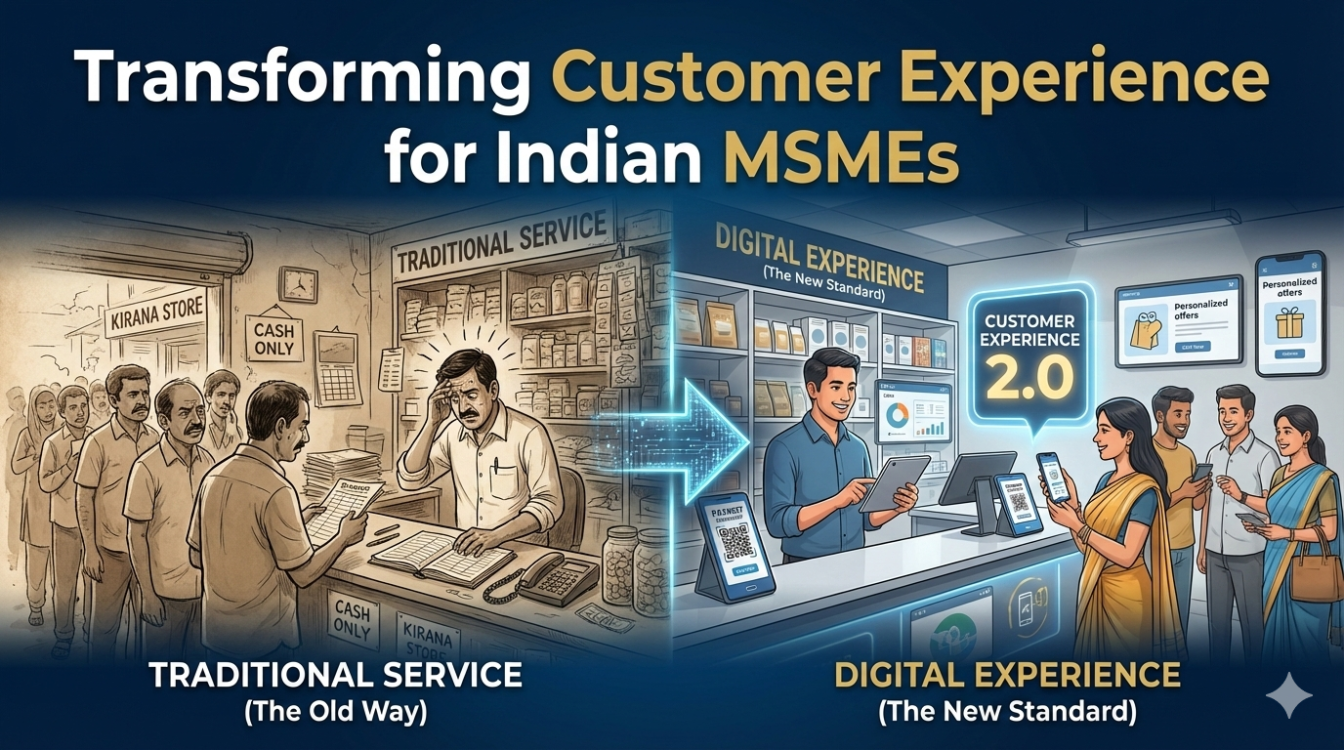
The rules have changed. Your customers now expect the same responsiveness from your 25-person MSME that they get from Amazon or Swiggy. They compare your service not to other MSMEs, but to the best digital experiences they encounter daily.
And here’s the uncomfortable truth: most Indian MSMEs are losing this battle without even realizing they’re in it.
The Customer Experience Crisis in Indian MSMEs
Let me paint a picture you’ll recognize. A potential customer visits your website, but there’s no live chat or immediate way to get answers. They call your office, but the person who answers doesn’t know product details and promises someone will call back. That callback happens two days later, after the customer has already purchased from a competitor.
Or this scenario. An existing customer has a complaint. They email you. The email sits unread for three days because nobody is specifically responsible for monitoring that inbox. By the time you respond, the customer has already posted a negative review online and told five other potential customers about their experience.
Or perhaps this one. A customer places an order. They have no way to track its status. They call to check. Three different people give them three different answers. The order arrives late. Nobody proactively informed them of the delay. There’s no apology, no explanation, just the assumption that “these things happen.”
These aren’t isolated incidents. This is the daily reality for thousands of Indian MSMEs. And it’s costing them dearly.
The Hidden Costs
Customer acquisition costs for MSMEs have increased dramatically over the past five years. Digital advertising is more expensive. Traditional referrals are less reliable. Getting a new customer now costs 5-7 times more than retaining an existing one.
Yet most MSMEs focus obsessively on acquiring new customers while providing mediocre experiences that ensure those customers don’t stay long or refer others. It’s like filling a bucket with a hole in the bottom and wondering why the water level never rises.
Poor customer experience shows up in metrics most MSMEs don’t even track. Customer lifetime value remains low because people don’t stick around long enough. Repeat purchase rates hover around 20-30% when they should be 60-70%. Referral rates are minimal because satisfied customers are rare. Online reviews are sparse or negative because experiences are inconsistent.
The compounding effect is brutal. A customer who has a poor experience tells an average of 10-15 people. In the age of WhatsApp groups and social media, that number can be much higher. One bad experience doesn’t just lose one customer. It potentially loses dozens of future customers who hear about that experience.
Meanwhile, your competitors who figure out customer experience are winning disproportionately. Their customers stay longer, buy more, and refer others. Their marketing costs decrease because word-of-mouth takes over. Their businesses scale because customer experience creates a moat that’s hard to cross.
Why Indian MSMEs Struggle with Customer Experience
The challenge isn’t lack of desire. Every MSME owner wants happy customers. The problem is structural, cultural, and operational.
No Ownership or Accountability
In most MSMEs, customer experience is everyone’s job, which means it’s nobody’s job. Sales handles pre-purchase interactions. Operations manages fulfillment. Accounts deals with billing. Customer service, if it exists at all, only gets involved when there’s a problem.
Nobody owns the end-to-end customer journey. Nobody is responsible for ensuring that every touchpoint delivers a consistent, positive experience. When something goes wrong, everybody points fingers at everyone else.
Inconsistent Processes
Customer experience depends heavily on who handles the interaction and what kind of day they’re having. Your best employee provides excellent service. Your average employee provides mediocre service. Your worst employee drives customers away.
There are no documented standards for how to handle common situations. Response time expectations aren’t defined. Complaint resolution processes don’t exist. Communication templates aren’t standardized. Everything depends on individual judgment and mood.
Technology Gaps
Many Indian MSMEs still operate on phone calls, WhatsApp messages, and paper records. Customer information is scattered across multiple systems or no system at all. There’s no centralized view of customer interactions, purchase history, or preferences.
When a customer contacts you, the person they speak with often has no context about previous conversations, orders, or issues. The customer has to repeat their story multiple times. This creates frustration and the impression that you don’t care enough to keep track.
Cost Concerns
Customer experience investments are often seen as luxury expenses rather than strategic priorities. Hiring dedicated customer service staff seems expensive. Implementing CRM systems feels like overkill. Training employees on customer service best practices gets deprioritized when there are fires to fight.
This short-term cost focus ignores the much larger cost of losing customers, negative word-of-mouth, and missed growth opportunities.
Cultural Mindset
Perhaps the deepest challenge is mindset. Many MSME owners still believe that product quality and price are the only things that matter. They view customer service as a necessary evil rather than a competitive advantage.
There’s an assumption that customers will tolerate mediocre experiences because “this is how business works in India.” But that assumption is dangerously outdated. Today’s customers, even in B2B contexts, have experienced world-class digital services and expect similar standards everywhere.
What World-Class Customer Experience Looks Like for MSMEs
You don’t need the budget of a multinational to deliver excellent customer experiences. You need clarity about what good looks like and systematic execution.
Fast, Reliable Communication
Customers reach out through multiple channels: phone, email, WhatsApp, website, social media. Regardless of the channel, they expect acknowledgment within minutes and substantive responses within hours, not days.
This doesn’t mean you need 24/7 support. It means you need clear response time standards and systems to ensure those standards are met. An automated acknowledgment saying “We’ve received your message and will respond within 4 hours” is infinitely better than silence.
Proactive Information Sharing
Customers shouldn’t have to chase you for updates. If there’s a delay in their order, tell them before they ask. If there’s a problem with their account, reach out proactively. If there’s new information relevant to them, share it without waiting for them to discover it.
This proactive approach transforms perception. Customers feel valued and informed rather than neglected and frustrated.
Consistent Quality Across Touchpoints
Every interaction should reflect the same level of professionalism and care. The person answering phones should be as knowledgeable and helpful as the owner. Email responses should be as prompt and complete as in-person conversations. The billing process should be as smooth as the sales process.
Consistency builds trust. Inconsistency breeds doubt and frustration.
Easy Problem Resolution
Problems will happen. Products will occasionally have defects. Deliveries will sometimes be late. Mistakes will occur. What separates good companies from bad isn’t the absence of problems but how quickly and fairly problems get resolved.
World-class customer experience means having clear escalation paths, empowered employees who can solve issues without endless approvals, and a bias toward making things right rather than defending company interests.
Personalization and Recognition
Customers want to feel recognized, not treated as transaction numbers. Remembering their preferences, acknowledging their history with you, and tailoring interactions based on what you know about them creates connection.
This doesn’t require sophisticated AI. It requires capturing basic information and training your team to use it. “Welcome back, Mr. Sharma. How did that last order of corrugated boxes work out for you?” is simple personalization that makes a huge impact.
Building Your Customer Experience Transformation Roadmap
Transforming customer experience isn’t a one-time project. It’s an ongoing commitment. But you can make dramatic improvements in 90 days by following a structured approach.
Phase One: Audit Your Current State
Start by understanding what your customer experience actually looks like today, not what you hope it looks like. This requires brutal honesty.
Map every touchpoint where customers interact with your business. First contact, inquiry response, quotation, order placement, production updates, delivery, invoicing, payment, post-sale support, complaint handling. What happens at each stage? How long does it take? How consistent is the quality?
Conduct customer interviews or surveys. Ask customers to describe their experience working with you. What do they love? What frustrates them? Where do you fall short of their expectations? Listen without defending. You’re seeking truth, not validation.
Mystery shop your own business. Have someone unknown to your team go through your customer journey. Call your office. Email inquiries. Place an order. Experience what your customers experience. The gaps between expectation and reality will become painfully clear.
Analyze your complaint data. What are customers complaining about? What patterns emerge? These complaints are gold because they show you exactly where experience breaks down.
Calculate your customer experience metrics. What percentage of customers make repeat purchases? How many refer others? What’s your Net Promoter Score? What’s your average customer lifetime value? These numbers establish your baseline.
Phase Two: Define Your Standards
Once you know your current state, define what excellent should look like for your business. This doesn’t mean copying others. It means establishing standards appropriate for your context and customer expectations.
Set response time commitments. How quickly will you acknowledge customer contacts across different channels? How quickly will you provide substantive responses? Be realistic but ambitious. If you currently take two days to respond to emails, commit to four hours and work toward achieving that consistently.
Create service level agreements for common requests. How long should quotation preparation take? How quickly should complaints get resolved? When should customers receive order updates? Document these standards so everyone knows what good looks like.
Define your customer communication style. What tone and language will you use? How formal or casual? What information will you always include? Creating templates and examples helps ensure consistency.
Establish quality standards for every touchpoint. What should a professional phone greeting sound like? What information should be included in quotations? How should complaints be acknowledged? Document the non-negotiables.
Phase Three: Build Your Systems and Processes
Standards without systems remain aspirations. You need practical mechanisms to deliver on your commitments.
Implement a customer relationship management system. This doesn’t need to be expensive or complex. Even a well-structured spreadsheet is better than scattered information. The goal is a single place where customer information, interaction history, and current status are visible to everyone who needs access.
For most MSMEs, cloud-based CRM tools like Zoho, Freshsales, or even Google Sheets with proper structure work perfectly fine. The technology matters less than the discipline of using it consistently.
Create communication workflows and templates. Document exactly how different situations should be handled. When a customer inquiry comes in, what happens? Who responds? What information gets gathered? How is it logged? Build email templates for common scenarios so responses are fast and consistent.
Set up automated acknowledgments where possible. When someone fills out your website contact form, they should immediately receive a confirmation email. When they place an order, automated confirmation with expected timeline should follow. These small automations dramatically improve perceived responsiveness.
Establish daily customer experience routines. Who checks which communication channels when? How often are customer-facing systems monitored? What’s the escalation process for urgent issues? Making these routines explicit ensures nothing falls through cracks.
Phase Four: Train and Empower Your Team
Your customer experience is only as good as your team’s ability and willingness to deliver it. This requires investment in training and empowerment.
Conduct customer service training for everyone who interacts with customers. This includes sales, operations, delivery personnel, and reception staff. Cover communication skills, problem-solving approaches, company standards, and common scenarios. Role-playing exercises help build confidence.
Create a customer service playbook documenting how to handle frequent situations. What do you say when a customer complains about late delivery? How do you handle a pricing objection? What’s the process for expediting urgent orders? This playbook gives your team confidence and ensures consistency.
Empower frontline staff to resolve issues. If a customer has a legitimate complaint and the solution costs less than a certain amount, your customer service person should be able to make it right immediately without getting approvals. Trusting your team and giving them authority to solve problems dramatically speeds resolution.
Make customer feedback visible to everyone. Share positive feedback publicly to reinforce good behaviors. Share complaints constructively to drive improvement. When everyone sees how their actions impact customer experience, behaviors change.
Phase Five: Measure and Improve Continuously
Customer experience transformation isn’t a destination. It’s a continuous improvement process powered by measurement and feedback.
Track your key customer experience metrics weekly. Response times, resolution times, customer satisfaction scores, repeat purchase rates, Net Promoter Score, customer lifetime value. What’s improving? What’s getting worse? Where are the opportunities?
Conduct regular customer feedback sessions. Monthly or quarterly, reach out to a sample of customers and ask about their recent experience. What went well? What could be better? What surprised them? This qualitative feedback provides context that numbers alone can’t capture.
Hold weekly customer experience review meetings with your team. What great things happened this week? What problems occurred? What did we learn? How can we prevent similar issues? Celebrate wins and problem-solve gaps together.
Continuously update your processes based on what you learn. Your initial standards and systems won’t be perfect. As you gather data and feedback, refine them. Better is always possible.
Common Obstacles and How to Overcome Them
Every MSME implementing customer experience improvements faces predictable challenges. Anticipating them helps you navigate successfully.
“We Don’t Have Budget for This”
Excellent customer experience doesn’t require large budgets. It requires commitment and systematic execution. Most improvements cost time and attention, not money.
Free or low-cost CRM tools exist. Communication templates cost nothing to create. Training can happen internally. Empowerment costs nothing. Start with these zero-cost improvements before worrying about budget.
Besides, poor customer experience is far more expensive than good customer experience. Calculate what losing customers costs you. That number usually dwarfs any investment required to improve experience.
“We’re Too Busy to Add More Work”
Customer experience improvements don’t add work. They reorganize existing work to be more effective. You’re already handling customer interactions. You’re just doing it inconsistently and inefficiently.
Documented processes, templates, and systems actually reduce work over time by eliminating confusion, rework, and fire-fighting. The initial investment pays dividends in operational efficiency.
“Our Customers Don’t Expect Premium Service”
This assumption is increasingly dangerous. Even price-sensitive customers notice and appreciate good service. They might not articulate it as “customer experience,” but they definitely notice when you’re responsive, reliable, and easy to work with.
Moreover, improving customer experience isn’t about becoming premium. It’s about being professional, consistent, and reliable. Those attributes matter at every price point.
“This Seems Like Too Much Change at Once”
You don’t need to transform everything simultaneously. Start with the highest-impact, easiest-to-implement improvements. Maybe that’s setting response time standards and creating email templates. Maybe it’s implementing a basic CRM. Maybe it’s training your reception staff.
Small wins build momentum. Each improvement makes the next one easier. Progress compounds over time.
The Competitive Advantage of Superior Customer Experience
Here’s what happens when you get customer experience right. Your customers stay longer because they have no reason to leave. Their lifetime value increases dramatically because they keep buying from you year after year.
Your customers buy more because trust has been established. They’re willing to try your other products or services. They’re less price-sensitive because they value the total experience, not just the product.
Your customers refer others. Happy customers become unpaid salespeople, telling colleagues, friends, and family about you. This word-of-mouth marketing is more effective and less expensive than any advertising you could buy.
Your marketing costs decrease. When customer retention improves and referrals increase, you need to spend less acquiring new customers to maintain growth. Your customer acquisition cost drops while lifetime value rises. This spread is pure profit.
Your team becomes more engaged. Delivering excellent customer experience and receiving positive feedback is motivating. Employees take pride in their work. Turnover decreases. Culture improves.
Your business becomes more valuable. Companies with strong customer loyalty, high repeat rates, and positive word-of-mouth command premium valuations. If you ever want to sell your business, customer experience directly impacts the price buyers will pay.
Most importantly, you build a sustainable competitive moat. Competitors can copy your products. They can match your prices. But replicating a culture and system that consistently delivers superior customer experience is much harder.
The Bottom Line
For Indian MSMEs, customer experience is no longer a nice-to-have. It’s a competitive necessity. The businesses that recognize this early and invest in systematic improvement will capture disproportionate market share from those that continue operating on outdated assumptions.
You don’t need massive budgets or revolutionary technology. You need clarity about what good looks like, documented processes to deliver it consistently, trained teams empowered to execute, and measurement systems to drive continuous improvement.
The transformation starts with one decision: to take customer experience as seriously as you take product quality or pricing. From that decision flows everything else.
Your customers are already comparing you to the best digital experiences they encounter daily. The question isn’t whether to improve your customer experience. The question is whether you’ll improve it before your customers move to competitors who already have.
The good news? Most of your competitors are still treating customer experience as an afterthought. The opportunity to differentiate is wide open. The question is whether you’ll seize it while the window is still open.
Start today. Audit one customer journey this week. Fix one communication gap. Create one template. Train one person. Small actions, executed consistently, compound into transformative results.
Your customers are waiting. What experience will you deliver?
The Perception Insights
By Vinod C. Pandita, Founder & CEO @ Perception Management Consulting Pvt. Ltd.