-
PX Consulting
- January 12, 2026
If you’re an MSME owner spending money on newspaper ads, pamphlets, trade shows, or cold calls and wondering why leads have dried up, you’re not imagining things.
The rules have fundamentally changed. And most small businesses are still playing by the old playbook.
Consider what happened to Priya, who runs a textile export business in Surat. Last year, she invested 8 lakhs in traditional marketing: trade magazine advertisements, exhibition stalls, direct mailers, and a sales team making cold calls.
Her result? Twelve qualified leads. Three conversions. Cost per customer: 2.67 lakhs.
This year, she shifted her entire approach to digital marketing with the same budget. The result: 147 qualified leads. Forty-two conversions. Cost per customer: 19,000.
That’s a fourteen-fold improvement in customer acquisition efficiency, using the same resources.
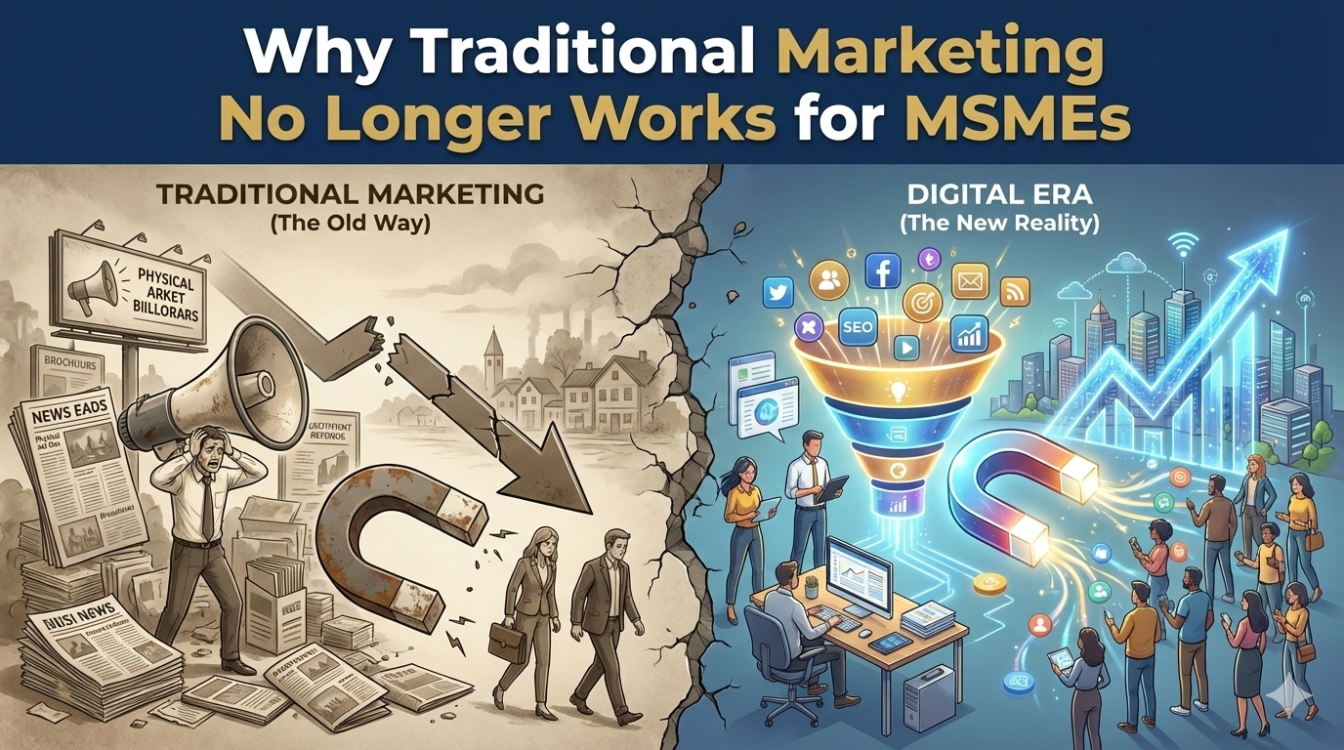
What changed? Everything about how buyers make purchasing decisions has fundamentally transformed in the last five years. The marketing tactics that worked in 2015 are not just less effective today—they’re often completely ineffective.
The Death of Traditional Marketing: Four Fundamental Shifts
1. Buyers Research Online Before They Ever Contact You
Your potential customers aren’t sitting around waiting for your sales call anymore. They’re not reading newspaper classifieds to find suppliers. They’re not flipping through trade magazines hoping to discover new vendors.
Instead, they’re searching on Google. They’re visiting your website or noting its absence. They’re reading online reviews and testimonials. They’re comparing your offerings with three or four competitors simultaneously. They’re watching video content about your industry. They’re checking your social media presence to gauge whether you’re a legitimate, active business.
According to recent studies, B2B buyers complete approximately 60-70% of their purchase decision before ever reaching out to a vendor. For B2C customers, that number is even higher.
If you’re not visible and credible during that critical online research phase, you simply don’t exist in their consideration set. Your beautiful brochure, expensive trade show booth, or persuasive sales pitch never gets a chance because you’ve already been eliminated before the conversation even starts.
Traditional marketing interrupts people who aren’t looking for you. Digital marketing helps people who are actively searching for solutions like yours to find you at exactly the right moment.
2. Traditional Channels Have Become Prohibitively Expensive with Poor ROI
Let’s talk about the hard numbers that many MSME owners avoid confronting.
A full-page advertisement in a regional newspaper costs anywhere from 50,000 to 3 lakhs depending on circulation and publication. How many people actually see it? Unknown. How many of those readers are actively looking for your product or service at that exact moment? A tiny fraction. How many take action? Almost impossible to measure.
A booth at a decent trade exhibition costs 1-3 lakhs when you factor in space rental, booth construction, materials, travel, and staff time. You might collect 200 business cards over three days. How many of those are qualified leads versus people collecting freebies? Perhaps 20-30. How many convert? Typically single digits.
Cold calling requires either hiring expensive sales staff or outsourcing to call centers. With increasing caller ID awareness and spam filtering, connection rates have plummeted. Most businesses report that only 1-2% of cold calls result in even a meaningful conversation, let alone a qualified lead.
Meanwhile, digital marketing offers dramatically better economics. A well-optimized Google Ads campaign can generate qualified leads at 500-2,000 rupees per lead depending on your industry. Social media advertising can reach thousands of precisely targeted potential customers for a few thousand rupees. Content marketing and SEO require time investment but generate compounding returns as your content continues attracting visitors month after month.
The cost-per-acquisition gap between traditional and digital marketing has widened so dramatically that continuing to invest heavily in traditional channels is essentially burning money for most MSMEs.
3. You Cannot Measure What’s Working
One of the most dangerous aspects of traditional marketing is the measurement problem. When you place a newspaper ad or distribute pamphlets, you have almost no ability to track what actually happens.
Did anyone see your ad? You have circulation numbers, but readership and attention are unknown. Did they visit your store or website because of the ad? Unless they specifically mention it, you’ll never know. Which specific message, offer, or creative approach worked best? Impossible to determine without expensive market research.
This measurement blindness means you’re making future marketing decisions based on gut feeling rather than data. You’re repeating tactics that might not work and abandoning approaches that could be effective, all because you can’t see what’s actually happening.
Digital marketing flips this entirely. Every click, every visitor, every lead source, every conversion is tracked and measurable. You know exactly which campaigns are profitable and which are wasting money. You can test different messages, audiences, and offers systematically, learning and improving continuously.
Within weeks of starting digital campaigns, you have concrete data about cost per click, conversion rates, customer acquisition cost, and return on ad spend. You can make informed decisions about where to invest more and where to cut spending.
For resource-constrained MSMEs, this ability to measure and optimize is perhaps the single biggest advantage of digital marketing. You can’t afford to waste money on ineffective marketing, and digital gives you the visibility to ensure every rupee is working hard.
4. Your Competitors Have Already Made the Shift
Perhaps the most compelling reason to abandon traditional marketing approaches is competitive reality. While you’re running newspaper ads, your competitors are dominating Google search results for the keywords your customers are using.
While you’re printing brochures, they’re creating YouTube videos that establish them as industry experts. While you’re making cold calls, they’re nurturing leads through email sequences that build trust over time. While you’re hoping people see your billboard, they’re retargeting website visitors with personalized ads that bring customers back.
The businesses that embraced digital marketing early have built significant advantages: established social media followings, high-ranking websites, libraries of valuable content, refined advertising systems, and databases of engaged leads.
Every month you delay this transition, you fall further behind competitors who are capturing market share through superior marketing efficiency. The gap widens, making it increasingly difficult to catch up.
What MSMEs Should Do Instead
The solution isn’t to abandon all forms of traditional marketing overnight. Some traditional tactics still have value in specific contexts, particularly for local businesses or certain B2B industries with older decision-makers.
But the allocation must shift dramatically. Here’s what a modern MSME marketing approach looks like:
Build a Strong Digital Foundation
Start with a professional, mobile-optimized website that clearly communicates what you do, who you serve, and why customers should choose you. This is your digital storefront and the hub of all marketing activity. Include clear calls-to-action, customer testimonials, case studies, and easy ways to contact you.
Claim and optimize your Google Business Profile so you appear in local search results and maps. Ensure your business information is consistent across all online directories. This foundational SEO work helps customers find you when they’re searching for solutions you provide.
Create Valuable Content Consistently
Develop blog posts, videos, or social media content that answers the questions your potential customers are asking. Share your expertise generously. This content serves multiple purposes: it attracts organic search traffic, establishes your credibility, provides material to share on social media, and nurtures leads by demonstrating your knowledge.
The key is consistency over perfection. One helpful article per week for a year will generate far better results than sporadic, irregular content creation.
Use Targeted Paid Advertising
Allocate a portion of your budget to Google Ads targeting high-intent keywords related to your products or services. People searching for “industrial pump supplier in Mumbai” or “custom packaging manufacturer” are actively looking to buy. Appearing at the top of those search results generates qualified leads efficiently.
Experiment with social media advertising on platforms where your customers spend time. Facebook and Instagram work well for B2C businesses and some B2B services. LinkedIn is powerful for B2B companies targeting professionals and decision-makers.
Start with small budgets, test different approaches, measure results rigorously, and scale what works. Digital advertising’s greatest advantage is this ability to start small and expand based on proven performance.
Build and Nurture an Email List
Collect email addresses from website visitors, customers, and prospects. Send regular valuable content, not just promotional messages. Email marketing consistently delivers the highest ROI of any digital channel because you own the audience and aren’t dependent on algorithm changes or platform policies.
A well-maintained email list becomes one of your most valuable business assets, allowing you to stay connected with customers, announce new products, share helpful information, and generate repeat business at minimal cost.
Leverage Social Proof and Reviews
Actively collect and showcase customer testimonials, reviews, and case studies. Modern buyers trust peer reviews more than any form of advertising. Make it easy for satisfied customers to leave reviews on Google, industry-specific platforms, or your website.
Video testimonials are particularly powerful. Even simple smartphone videos of customers explaining how you solved their problems carry enormous credibility.
Making the Transition: A Practical Roadmap
If you’re currently spending heavily on traditional marketing, the transition should be strategic rather than abrupt.
Quarter One: Build Your Foundation
Invest in a professional website if you don’t have one or update your existing site if it’s outdated. Claim and optimize all business listings online. Set up basic analytics so you can start measuring digital traffic and conversions. Create social media profiles on platforms relevant to your business.
Quarter Two: Start Creating Content
Begin publishing one piece of valuable content per week, whether that’s blog posts, videos, or detailed social media posts. Focus on answering the questions your customers ask most frequently. This content library becomes the fuel for all other digital marketing activities.
Quarter Three: Launch Paid Campaigns
Start small paid advertising campaigns on Google or social media with 10-20% of your marketing budget. Test different messages and audiences. Measure everything. Learn what generates qualified leads at acceptable costs.
Quarter Four: Optimize and Scale
Analyze six months of data to understand what’s working. Double down on successful channels and tactics. Reduce or eliminate traditional marketing spending that shows poor returns. Reallocate that budget to proven digital approaches.
This gradual transition allows you to test and validate digital marketing’s effectiveness for your specific business without taking excessive risk. You’re not abandoning traditional marketing based on theory but based on measurable results from your own campaigns.
The Bottom Line
Traditional marketing hasn’t completely died for every business in every situation. But for the vast majority of MSMEs, it has become dramatically less effective while simultaneously becoming more expensive.
The fundamental behavior change in how customers research and make buying decisions means that businesses invisible online are invisible to potential customers. The superior measurement and optimization capabilities of digital marketing mean limited budgets can be deployed far more efficiently.
Perhaps most critically, the competitive dynamics have shifted. Your competitors who have embraced digital marketing are acquiring customers more efficiently, scaling faster, and building sustainable advantages. Continuing to rely primarily on traditional marketing approaches isn’t just inefficient—it’s an existential competitive threat.
The question isn’t whether to make this transition but how quickly you can execute it while learning the new skills and approaches required. The businesses that adapt fastest will capture disproportionate market share from those that continue operating on outdated assumptions about how marketing works.
The good news? Digital marketing is more accessible to MSMEs than traditional marketing ever was. You don’t need massive budgets to compete. You need knowledge, consistency, and willingness to measure and learn. Those attributes favor scrappy, nimble small businesses over large traditional competitors still locked into expensive traditional approaches.
Your next customer is searching online right now. The only question is whether they’ll find you or your competitor.
The Perception Insights
By Vinod C. Pandita, Founder & CEO @ Perception Management Consulting Pvt. Ltd.